
Freemium Conversion: How B2C and B2B Design Decisions Differ
A B2B project tool ported its freemium tier to consumers and watched 6.2% conversion crater to 0.8%. Removing the collaboration gate, dropping the 3-project cap, and adding a $3.99 student tier moved it back to 2.6% in 90 days. The numbers behind B2C versus B2B free-tier design.
Emily Ellis · 2025-05-14
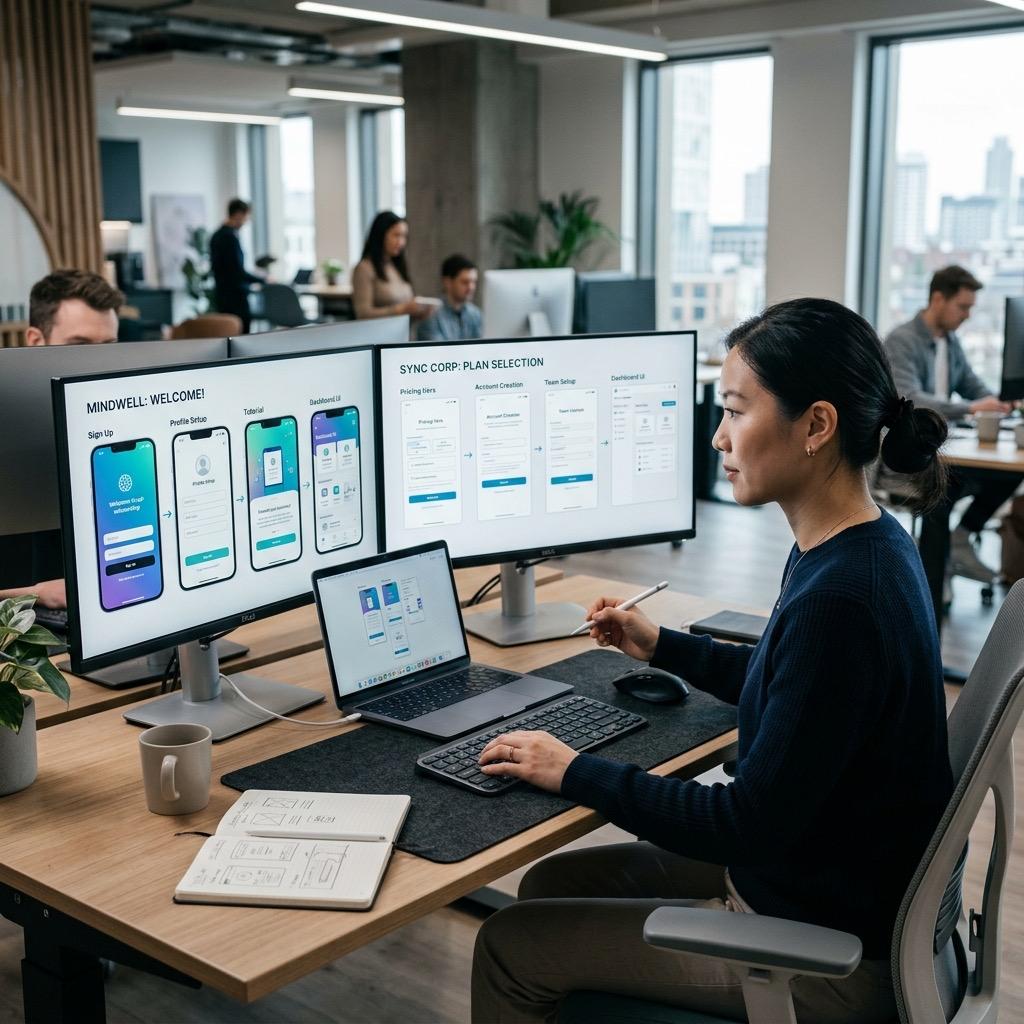
Freemium sounds like a universal model. It isn't. The mechanics that drive freemium conversion in a B2C consumer app are fundamentally different from the ones that drive it in a B2B SaaS tool. Build the wrong freemium tier for your context and you'll either convert almost nobody or give away so much value that paid looks pointless.
The Numbers First
B2C consumer apps: 1-4% paid conversion on freemium, with most sitting around 2-3%. That's not a failure. Spotify converts roughly 2.3% of its monthly active user base globally to paid. At 600 million monthly users, that 2.3% generates a business worth over $12B in revenue annually. The model works through scale and low customer acquisition cost (CAC), not through high conversion rates.
B2B SaaS freemium: 3-8% conversion on qualified free accounts (accounts that have activated past initial signup). Slack converted around 30% of active free teams to paid during its growth phase - but "active" is doing a lot of work in that number. If you count all signups including dormant ones, the number drops significantly. The realistic B2B benchmark for a well-designed freemium tier is 5-8% of accounts that have hit your activation threshold.
The gap between B2C and B2B isn't willingness to pay. Both consumer and business users will pay for something they genuinely value. The gap is decision authority.
Decision Authority Is the Real Variable
A consumer deciding whether to upgrade your app is making a personal spending decision. They're comparing your premium tier against their Netflix subscription, their gym membership, and their take-out habit. There's no ROI calculation. It's a value-and-emotion decision made by one person who controls their own wallet.
A B2B user deciding whether to upgrade your tool is often also making a personal decision - but with a budget they don't personally control. In companies with fewer than 50 employees, the person using your product often has a company card and converts quickly. In companies with 200+ employees, there's an approval process, a procurement policy, and sometimes a legal review.
This means your freemium design needs to account for two different things depending on your market:
For B2C: optimize for habit strength and emotional readiness. The conversion happens when the user has formed enough of a habit that the friction of the free tier (ads, limits, watermarks) is genuinely annoying. Before that habit forms, no upgrade prompt will work regardless of how it's worded.
For B2B: optimize for organizational visibility. The more people inside a company who see value from your free tier, the more internal pressure there is to move to paid. Slack's free tier doesn't limit features much - it limits message history to 90 days. That limit doesn't hurt one person. It hurts the whole team, creating internal pressure for someone with budget authority to approve the upgrade.
How to Design Your Free Tier for the Right Conversion Economics
The architecture question is: what does your free tier give users, and where does it stop?
Three models, and when each works:
The Usage Cap model works best in B2C. Give the user full access to the core product but cap the volume of use (storage, messages, projects, exports). The user builds habits on the full product experience and hits the cap when they're genuinely invested. Dropbox's 2GB free storage was the canonical example - enough to understand the product, not enough to live on it.
The failure mode: setting the cap too low (users hit it before they're habituated and leave) or too high (users never hit it and never have a reason to pay). Calibrate the cap to fire when approximately 30-day retained users are likely to hit it, not when day-one users are.
The Feature Gate model works best in B2B. Give the free user enough capability to do meaningful work, but reserve collaboration, admin, analytics, or integration features for paid. This works in B2B because those gated features have clear organizational value - "we need the reporting to show the board" is a fundable request. In B2C, feature gates often feel arbitrary because consumers aren't running quarterly reviews.
The failure mode: gating features nobody actually wants. Run a usage analysis before you decide what to gate. The right features to gate are the ones that 30-day retained users are actively using - those indicate value. Gating features that free users ignore doesn't drive upgrades, it just looks like a bad deal.
The Watermark/Branding model is a B2C-specific approach used by Canva, Loom, and others. The free product delivers full functionality but outputs carry your brand. For professional users (small businesses, freelancers), removing the watermark or branding becomes the upgrade driver because it affects how they present to clients. This only works when your free-tier output is something the user shares externally - if the output stays internal, the brand friction never fires.
The Mistake B2B Teams Make in B2C
B2B SaaS teams that move into B2C frequently apply the feature gate model to a consumer context and wonder why it doesn't convert.
A project management tool expanded from a B2B product into a consumer version targeted at students and freelancers. They kept their B2B gate structure: free tier limited to 3 projects, templates, and collaboration features locked behind paid. B2B conversion had been 6.2%. Consumer conversion came in at 0.8%.
The problem was structural. Students don't need collaboration features. The 3-project limit hit them on day four before they had any habit. And the upgrade prompt offered team features they didn't need. The free tier design was built for a B2B conversion psychology applied to users with consumer decision patterns.
They rebuilt: unlimited projects, removed the collaboration gate, and introduced a cap on storage and template access instead. Added a student discount at $3.99/month (versus $12/month for the B2B tier). Consumer conversion moved to 2.6% in 90 days.
The B2C-Specific Upgrade Trigger: Price Anchoring
B2C conversion is also more sensitive to price anchoring than B2B. When a consumer sees a $9.99/month upgrade option, they anchor to streaming services. When they see $19.99/month, the mental comparison shifts to gym memberships. When they see $4.99/month, they compare it to a coffee.
Annual pricing in B2C dramatically outperforms monthly for conversion rates - typically 25-40% higher paid conversion on annual plans because the monthly equivalent is lower and the commitment threshold creates urgency. Offer the annual plan prominently. Don't bury it.
In B2B, pricing anchors to per-seat economics and organizational budgets. A $25/user/month doesn't feel expensive to a 10-person team if it replaces a manual process - it's a $250 line item in a P&L that's probably already absorbing $3,000 in salaries for the same task.
The Test Worth Running
Before you invest in optimizing your upgrade prompts, run this diagnostic: segment your free users into those retained at Day 7 and those who churned before Day 7. Look at the paid conversion rate for each group separately.
In nearly every case, Day-7 retained users convert at 5-8x the rate of the full free user base. That tells you your freemium conversion problem isn't the prompt or the pricing - it's the retention rate before users reach the conversion-ready state. Fix the habit formation first.
To map where your product growth motion is breaking down, start your free pricing assessment.
Company names and figures in worked examples are illustrative or changed to protect client confidentiality.
Talk this through with an operator, or score your own commercial system first.