
36% List-to-Pocket Leak in One Channel. Blended Hid It.
The pocket-price waterfall is the single most diagnostic exercise a multi-channel operator can run. It exposes the gap between list and realized margin at the line-item level. And it almost always reveals that the cleanest channel on the P&L is hiding the messiest discounting behavior underneath.

The Pocket-Price Waterfall: A Channel-by-Channel Diagnostic for Finding the Margin You Already Earned
The dollar you already earned
Most commercial teams do not have a pricing problem in the way they think they do. They are not mispriced on the shelf or the rate card. They have a realization problem. The dollar left the customer. It simply did not arrive.
The pocket-price waterfall is the exercise that makes the absence of arrival visible. It is a line-by-line decomposition of every deduction between the published list and the net revenue that clears after every rebate, allowance, freight absorption, co-marketing contribution, trade-spend commitment, promotional credit, and term cost. Run properly, it is the most diagnostic piece of work a multi-channel operator can do in a quarter. Run as a blended company-level average, it is one of the most misleading.
The exercise is not confined to physical goods. A software company that sells one product through direct enterprise sales, a partner channel, and self-serve has three routes to market too, and a software company with a single route still has deal types: single-year, multi-year, prepaid, pilot. A waterfall built by deal type finds the same thing a waterfall built by channel finds. The book everyone is proud of is the one hiding the deepest discount. The second half of this guide applies the method to a software book. For the definition and the six stages of a SaaS waterfall, start with the price waterfall concept page. For the reconciliation mechanics when the CRM and the billing system disagree, read Price waterfall analysis: how to build one.
TL;DR: Build the waterfall by channel, not blended. Categorize every deduction as governed or ungoverned. Retire or restructure only what fails a specific test. Install it as a quarterly control surface. Expect 150-300 bps of margin recovery on the messiest channel and the clarity to defend every concession that remains. Then run the same waterfall on a software book by deal type, and put pocket-price realization on the monthly dashboard so the leakage cannot return unannounced.
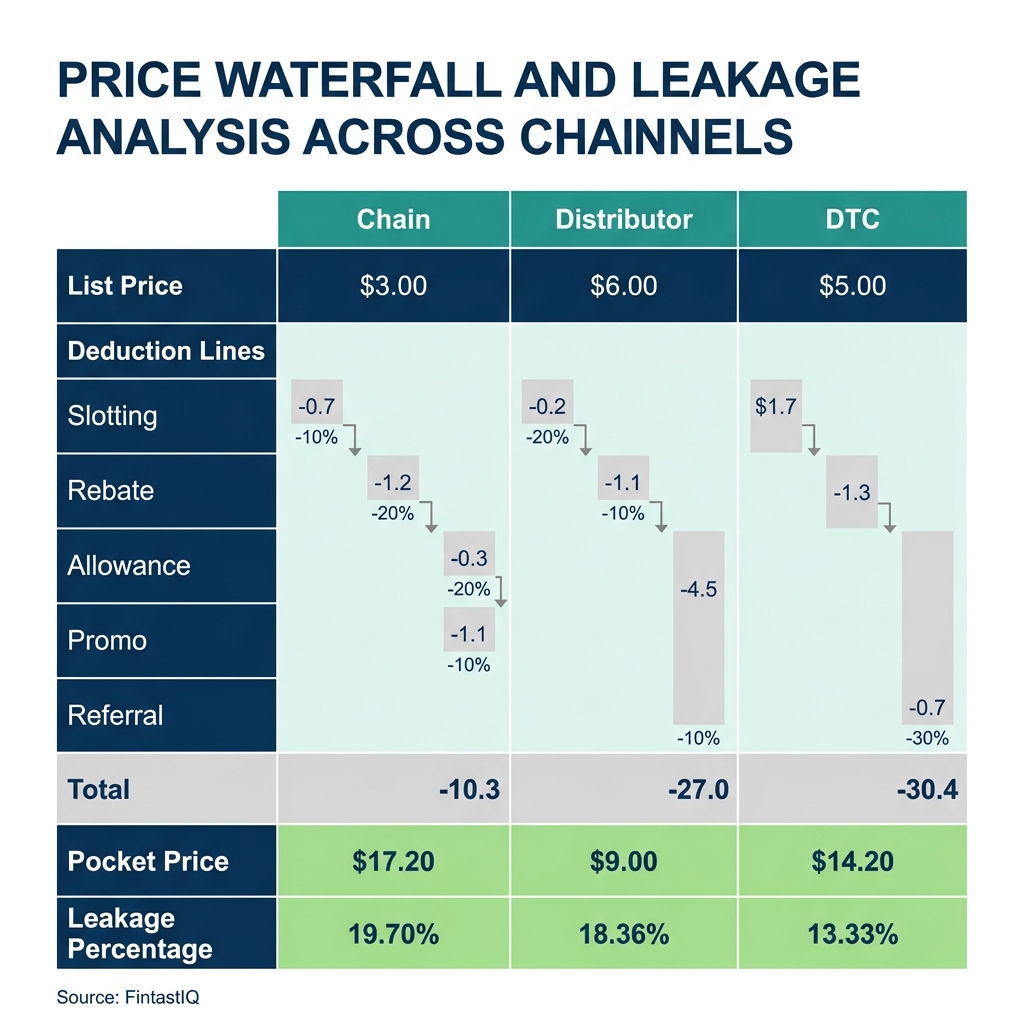 Exhibit: Three-channel pocket-price waterfall
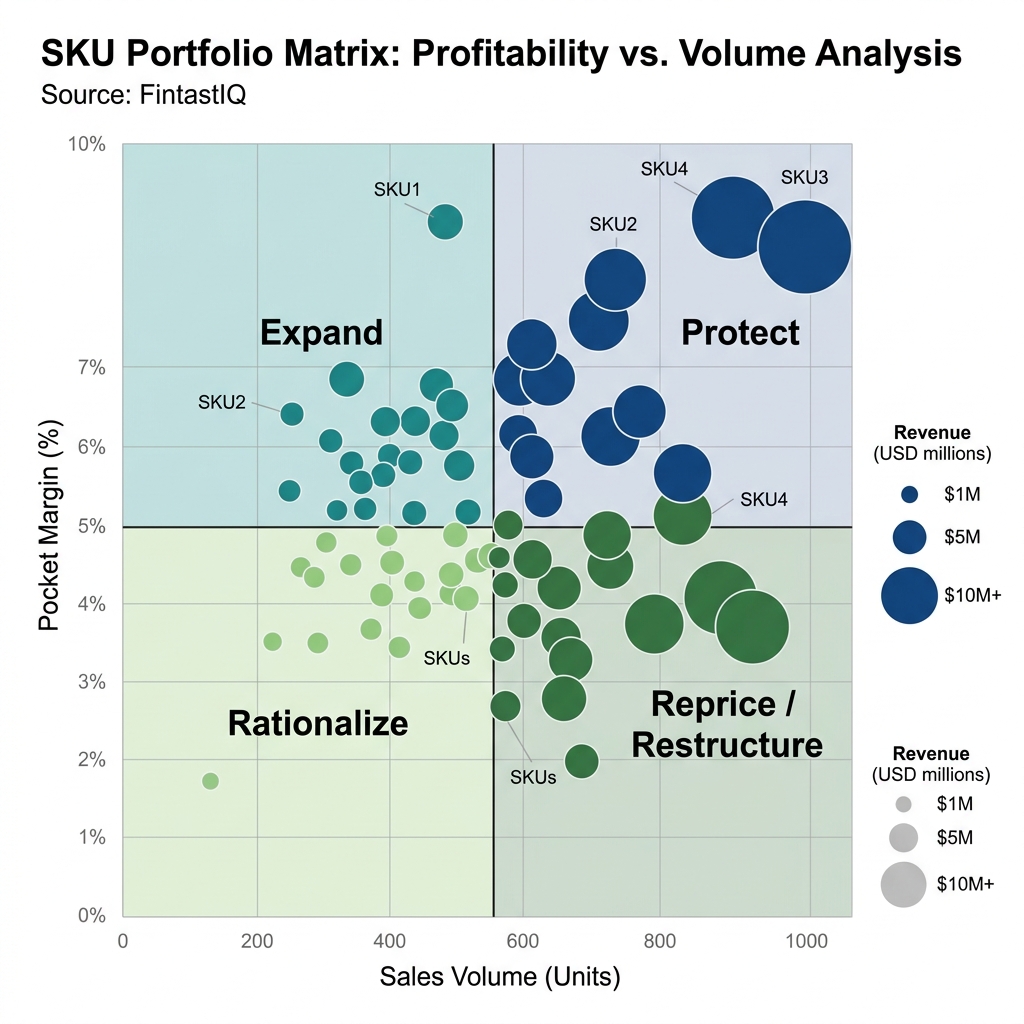 Exhibit: Pocket-margin-by-SKU 2×2 matrix
A working example: Birchweave & Co
Birchweave & Co is a B2B branded foodservice supplier. Seventy-five people, $32M in revenue, 62 SKUs across premium coffee concentrates, flavor syrups, and dairy substitutes. The go-to-market runs three routes: 14 national restaurant-chain accounts on 24-month contracts, 8 regional distributors servicing independent operators, and a direct-to-operator e-commerce channel. Mix is 48 percent chain, 34 percent distributor, 18 percent DTC. MAP enforcement is in place. Trade-spend accruals are clean enough to pass an audit.
On paper, Birchweave looked like a disciplined mid-market specialty business. Gross margin was holding in its target band. The commercial team was performing to plan.
The head of commercial finance, Alasdair, noticed that every channel conversation at the operating table was anchored on the chain book. Distributor economics came up only when a specific distributor did. DTC was discussed almost exclusively in marketing terms. No one had ever put a single waterfall on the table that showed all three routes on the same unit basis. Alasdair built it.
The chain waterfall started at a list price of $11.20 per unit and resolved to $7.18. The leakage was 36 percent, in five buckets: 14 percent promotional slotting, 8 percent co-marketing funds, 6 percent EDLP rebate, 5 percent freight allowance, and 3 percent menu-placement bonus. Each program had been authorized at a different time by a different commercial lead. None had been reviewed together.
The distributor waterfall started at $10.40 and resolved to $8.02. A 23 percent leakage across a 9 percent volume tier, 7 percent growth rebate, 4 percent new-door incentive, and 3 percent cash-terms discount.
The DTC waterfall started at $14.95 and resolved to $13.71. An 8 percent leakage consisting of a 5 percent first-order promo and a 3 percent referral credit. Clean, small, and known.
The chain and distributor waterfalls had never been seen in this form by the board. The DTC waterfall was, in Alasdair's phrase, "the only one that did not make me uncomfortable." The uncomfortable waterfalls are where the work is.
The four-part method
(a) Build the waterfall by channel, not blended
The first discipline is the most violated. Blended waterfalls are comfortable because they aggregate the chaos into a number the whole commercial team can live with. Channel waterfalls are uncomfortable because they force every revenue leader to see their own book without the averaging that protected them.
Build one waterfall per route to market, on a unit basis, using the same denominator. If you sell a coffee concentrate through chains, distributors, and DTC, every waterfall is built on one case of that SKU. Do not normalize to a blended unit. Do not average across pack sizes. The comparability is the point.
Start at the published list price for the channel. Subtract every deduction in sequence: contractual discounts, rebates, allowances, promotional programs, logistics absorptions, term and financing costs, and the silent concessions that appear in credit memos but were never codified in the contract. What remains is the pocket price.
This is not accounting. The waterfall is a commercial document that rearranges accounting data in the shape of a decision. Pricing is a signal before it is a number, and the waterfall is how you read the signal each channel is broadcasting about its own discipline.
(b) Categorize every line as governed or ungoverned
Every deduction falls into one of two categories. Either it was authorized by someone with the seat to authorize it, documented, capped in dollars or percentage, sunsetted, and reconcilable against a specific buyer behavior. Or it was not.
Governed concessions are fine. They may be generous, they may be renegotiable, but they are under control. You can defend them to a board.
Ungoverned concessions are the inventory of problems. A freight allowance introduced to win a single account three years ago that has since propagated to every account is ungoverned. A co-marketing fund with no campaign tied to it is ungoverned. A volume rebate paying on thresholds the customer is guaranteed to hit is ungoverned. A new-door incentive that never expires is ungoverned.
At Birchweave, the categorization flagged six ungoverned lines on the chain waterfall and four on the distributor waterfall. DTC had none. Governance collapses in the channel with the largest accounts, the longest contracts, and the most relationship-driven negotiations, because every ungoverned concession feels like a small accommodation until it is viewed beside the others.
(c) Decide what to retire and what to restructure
Discounting is usually a symptom. The task on the other side of the waterfall is not to eliminate concessions. It is to decide which ones are buying you something and which ones are not.
A line is a candidate for retirement if it meets two of the following: it has no expiry, it stacks with another program targeting the same behavior, it was authorized below the seat threshold required by policy, or its removal would not measurably change buyer behavior. A line is a candidate for restructuring if it is doing useful work but is poorly shaped, typically by lacking a sunset, a cap, or a clear performance trigger.
Birchweave retired six layered rebate lines on the chain book that stacked redundantly against the same volume behavior. Two promotional programs on the distributor book were consolidated into a single quarterly structure. One new-door incentive was rebuilt with a six-month sunset and a per-door cap, replacing what had been an open-ended program. DTC was untouched. The best operators compete on discipline, not instinct. Restructuring is how you install the discipline without abandoning the commercial relationships discounting was trying to serve.
(d) Install the quarterly pocket-price review
A waterfall run once is a diagnostic. A waterfall run quarterly is a control surface.
The review has a fixed agenda. Refresh each channel waterfall against the prior quarter. Identify every movement greater than 25 basis points, up or down, and attach a one-paragraph narrative. Flag any new concession introduced during the quarter. Reconcile governed versus ungoverned line counts. Document the dollar impact of any retirement or restructuring decisions.
The review is owned by commercial finance, chaired by the head of commercial finance, and attended by the channel commercial leaders. The CFO attends once a quarter. The board sees the summary annually. Pricing maturity is measured by what you stop doing, and the review is how you stop doing the things the waterfall keeps flagging.
Birchweave installed the review in the quarter after Alasdair's first build. By the fourth quarter, chain pocket-price was up 240 bps, distributor up 180 bps, DTC unchanged by design, and the consolidated annualized gross-margin lift was $1.1M. No list-price increases were taken. No customers were lost.
The same waterfall in software: seven steps from list to pocket
Most software companies do not know what they charge either. They know list. They do not know pocket price, the cash that clears after every concession, waived fee, extended term, and service credit is accounted for. At a $40M ARR company with an 8 percent list-to-pocket leak, that is $3.2M of margin a year that the P&L never attributes to a decision. There is no line item called unauthorized discounts. The loss shows up as lower realized ACV and gets blamed on the market. Across a sponsor's portfolio of eight companies that size, the recoverable margin clears $25M a year, and none of it requires a price increase, a product change, or a customer-facing action. It requires governance.
The seven steps below are the software version of the channel build. Each has a failure mode, and the failure modes are where most first attempts stall.
1. Start at list, not at average contracted price
The waterfall is a descent from list to pocket. Every step down is a concession, and until you know list you cannot measure decay. Document the current list price for every SKU, and make sure list reflects what the pricing page says today, not what marketing published two years ago. The failure mode is using the average contracted price as the top of the waterfall. That is not list. That is the top of the next step down.
2. Measure rep-level discount leakage
Unauthorized discounts are almost always the largest bucket. Reps close deals by quietly moving a few points off list without approval, and the points add up. Pull the last 90 days of closed-won deals, compare the quoted price to the list price on the same SKU at the time of sale, and flag every instance above the approval threshold that lacks documented sign-off. The failure mode is calling sales-led discounting the cost of doing business. It is the absence of governance.
3. Measure implementation and onboarding fee waivers
Implementation fees are the most commonly waived concession. A waived $15K implementation fee on a $100K first-year contract is a 15-point margin hit that no discount field records. Pull the last 50 enterprise contracts, count how many waived implementation, and sum the dollar value. The failure mode is accepting "we waived it to close" as the explanation. Sometimes that is true. Often the deal would have closed anyway.
4. Measure auto-renewing temporary discounts
A temporary 10 percent discount granted two years ago to close a deal frequently renews forever, because nothing flags it for expiration. Audit every active discount code, identify the ones that were intended to be temporary, and calculate the cumulative margin cost of the set that auto-renewed. The failure mode is assuming the CRM flags temporary discounts correctly. It usually does not.
5. Measure extended payment terms
Net-90 or Net-120 terms function as interest-free loans. The net present value impact is real margin, and it rarely appears as a pricing concession anywhere. Audit payment terms on the top 100 customers, flag everyone beyond Net-30, and calculate the implied interest cost. The failure mode is treating payment terms as a finance concern rather than a pricing concern. The cost lands in working capital and never gets attributed to the deal that created it.
6. Measure service credits and uncredited failures
Service credits granted for outages or escalations reduce pocket price directly. Uncredited failures that raise churn risk reduce it indirectly. Audit the credits issued in the last 12 months, cross-reference them against escalations that did not produce a credit, and quantify both. The failure mode is a generous credit policy that leaks margin without buying the satisfaction it was designed to buy.
7. Rebuild the waterfall as a monthly dashboard
A one-time waterfall analysis is an artifact. A waterfall updated monthly is governance. Instrument the CRM and the ERP to report pocket-price realization every month, and make it a standing agenda item in the operating review. The failure mode is running the analysis once, presenting the slide, and never updating it. Leakage returns within two quarters.
Multi-year deals at 42 percent below list: Quillhaven Legal
Quillhaven Legal is a $35M ARR legal technology platform two years into a private equity hold. The board tracked bookings and new logos closely. Nobody tracked average realized price. The sales team had a published discount authority matrix, but it had not been updated in three years and said nothing about multi-year deals, which had become 60 percent of new bookings.
A waterfall split by deal type found that multi-year deals averaged 42 percent below list once the headline discount and the multi-year credit were both counted. Single-year deals averaged 18 percent. The multi-year conversion rate looked excellent in the bookings report. The pocket price told a different story.
Before: $35M ARR, 42 percent average discount on multi-year deals, no approval process for multi-year deal economics, ASP declining quarter over quarter with no board visibility.
After: Multi-year economics added to the approval matrix, a minimum year-one ACV floor for any multi-year deal, and monthly ASP by deal type at board level. Average multi-year discount fell from 42 percent to 26 percent over three quarters. Incremental ARR of $2.8M a year with no change in multi-year conversion.
The repair was governance, not compensation. Deal governance protects margin; sales comp alignment keeps it. Quillhaven changed the approval matrix first and the comp plan a year later, in that order, and the order is the lesson.
Four failure modes
Blended waterfall hides channel sins. A consolidated waterfall produces a number the whole team can tolerate. The chain team feels fine because its leakage is averaged against DTC. DTC feels fine because its volume is small. Distributor feels fine because nobody is asking sharp questions. Birchweave had this pattern for years. The remedy is mechanical: never present a pocket-price waterfall in aggregate without the per-channel breakdown sitting beside it. In software the same sin is a blended discount rate that averages single-year deals against multi-year ones.
The retire-everything reflex. A first waterfall typically produces a wave of embarrassment followed by a reflex to cancel every ungoverned program in the next 60 days. This is how commercial trust is destroyed in a quarter. Concessions exist because they were, at some point, buying something. The task is to determine what, not to assume nothing.
No sunset on new concessions. The most reliable predictor of whether a pricing program will become ungoverned is whether it has an end date. Programs introduced without a sunset become permanent features of the cost base within two quarters. Every new concession, without exception, should carry a sunset clause, a cap, and a named owner. If a program deserves to be extended, the renewal conversation is trivial.
The one-time slide. The waterfall gets built for a board meeting, the slide lands well, and the file is never opened again. Without the quarterly review and the monthly realization number, the concessions that were retired come back under new names, because the behavior that created them was never governed, only its output. A waterfall that is older than a quarter is history. The install section below is how you keep it live.
Diagnostic questions
- What is the dollar gap between list price and pocket price across your top 50 accounts, by channel or by deal type?
- On each waterfall, which deductions are governed, and which have no owner, no cap, and no sunset?
- How many closed-won deals in the last 90 days carried discounts above your approval threshold without documented sign-off?
- How many implementation fees were waived in the last 50 enterprise contracts, and what did they total?
- How many active discount codes in your system were originally labeled temporary?
- How many of your top 100 customers are on payment terms extended beyond Net-30?
- What is the total dollar value of service credits issued in the last 12 months?
- Is pocket-price realization reported monthly, and does one person own the number?
Common mistakes
Treating list price as the relevant number. Halyard Software, a $50M ARR company, reported 6 percent pricing power year over year on list. Pocket price fell 2 percent over the same period, because discounting absorbed the increase and then some. The pocket price is the only price that matters. Everything above it is a story you are telling yourself.
Waiving implementation fees by reflex. Corbel Systems, at $30M ARR, had waived implementation on 72 percent of enterprise deals. A formal fee-waiver approval workflow, with a written justification above a dollar threshold, recovered $1.8M of annual margin in the first year without changing the fee itself.
Ignoring payment terms as a pricing concession. Netherby Software, at $40M ARR, carried $3M of ARR on Net-120 terms. The implied working capital cost was $180K a year, and nobody owned it, because finance saw a collections number and sales saw a closed deal.
Running the waterfall once. Pellston Labs, at $25M ARR, analyzed its waterfall, presented the slide to the board, and never revisited it. Leakage returned to the original level within three quarters. The company had bought a diagnosis and skipped the treatment.
The 30-60-90 install
First 30 days. Commercial finance builds the first-pass waterfall for each channel on the same unit basis. Every line item is categorized as governed or ungoverned. Circulated to commercial leadership and the CFO only. No decisions taken. The objective is a defensible, reconcilable baseline. For a software book, the same window covers the 90-day billing pull, the rep-level discount audit, and the fee-waiver count, built by deal type.
Days 31-60. Commercial leadership reviews the waterfalls with commercial finance and identifies retirement and restructuring candidates. Each candidate is tested against the four retirement criteria. A written decision memo is produced for each line acted upon. Customer-facing changes are sequenced to land at natural contract or program renewal points. Auto-renewing discount codes are audited and the ones past their intended term are expired.
Days 61-90. The quarterly pocket-price review is installed as a standing cadence. The first review is held in this window with the refreshed waterfalls, the documented retirement and restructuring decisions, and the before-and-after delta. Board reporting is updated to include the channel waterfall summary. A lightweight monthly refresh is put in place for the top two channels, and pocket-price realization joins the monthly operating dashboard so the number is seen twelve times a year, not once.
Exhibit 1: The three-channel pocket-price waterfall
BIRCHWEAVE & CO: POCKET-PRICE WATERFALL BY CHANNEL (PER UNIT)
                                    Chain      Distributor     DTC
List price                         $11.20         $10.40      $14.95
  Promotional slotting             (1.57)              -           -
  Co-marketing fund                (0.90)              -           -
  EDLP rebate                      (0.67)              -           -
  Freight allowance                (0.56)              -           -
  Menu-placement bonus             (0.34)              -           -
  Volume tier                          -          (0.94)           -
  Growth rebate                        -          (0.73)           -
  New-door incentive                   -          (0.42)           -
  Cash-terms discount                  -          (0.31)           -
  First-order promotional              -               -       (0.75)
  Referral credit                      -               -       (0.45)
                                  -------        -------     -------
Pocket price                       $7.18           $8.02      $13.71
Leakage from list                    36%             23%          8%
Governed lines                         -               1           2
Ungoverned lines                       5               3           -
Action                         Retire 6,      Consolidate    No change
                               restructure 1    2, rebuild
                                              1 with sunset
Exhibit 2: Pocket-margin-by-SKU, four-quadrant matrix
                            POCKET-MARGIN-BY-SKU MATRIX
                              (applied to all 62 SKUs)

                       LOW VOLUME                   HIGH VOLUME
                 +-----------------------+-----------------------+
                 |                       |                       |
   HIGH POCKET   |   Q1: PROTECT         |   Q2: EXPAND          |
   MARGIN        |                       |                       |
                 |   Niche specialty     |   Core franchise      |
                 |   SKUs with pricing   |   SKUs with pricing   |
                 |   power. Guard        |   power AND scale.    |
                 |   carefully; these    |   The business runs   |
                 |   are the unit        |   on these. Invest    |
                 |   economics anchor.   |   in availability.    |
                 |                       |                       |
                 +-----------------------+-----------------------+
                 |                       |                       |
   LOW POCKET    |   Q3: RATIONALIZE     |   Q4: REPRICE OR      |
   MARGIN        |                       |       RESTRUCTURE     |
                 |   Low volume, low     |                       |
                 |   margin, often       |   High volume, low    |
                 |   legacy. Candidates  |   margin. The         |
                 |   for discontinuation |   channel leakage     |
                 |   or repositioning.   |   lives here. Fix     |
                 |                       |   the waterfall       |
                 |                       |   before cutting.     |
                 |                       |                       |
                 +-----------------------+-----------------------+
Exhibit 3: The software waterfall by deal type
QUILLHAVEN LEGAL: POCKET-PRICE WATERFALL BY DEAL TYPE (PER $100 OF LIST)
                                     Single-year      Multi-year
List price                              $100.00         $100.00
  Headline negotiated discount           (14.00)         (22.00)
  Multi-year credit                           -          (12.00)
  Free implementation                     (3.00)          (5.00)
  Extended payment terms                  (1.00)          (3.00)
                                        -------         -------
Pocket price                             $82.00          $58.00
Leakage from list                           18%             42%
Share of new bookings                       40%             60%
Governed lines                                2               1
Ungoverned lines                              2               3
Action                            Approval matrix   Year-one ACV floor,
                                  by depth          multi-year economics
                                                    in approval matrix
Leakage after three quarters                17%             26%
Two ways to take this further. Book a discovery call to walk your own waterfall with an operator, or Score your pricing readiness to see where realization ranks among your commercial gaps.
References
Marn, Michael V., and Robert L. Rosiello. "Managing Price, Gaining Profit." Harvard Business Review, September-October 1992. The founding text. https://hbr.org/1992/09/managing-price-gaining-profit
Marn, Michael V., Eric V. Roegner, and Craig C. Zawada. The Price Advantage. Wiley, 2004. The book-length treatment of the waterfall and the pocket-price band.
Nagle, Thomas T., and Georg Müller. The Strategy and Tactics of Pricing. Routledge, 7th edition, 2023. The operating manual.
Simon, Hermann. Confessions of the Pricing Man. Copernicus, 2015. Useful for framing conversations with non-finance leaders.
Ramanujam, Madhavan, and Georg Tacke. Monetizing Innovation. Wiley, 2016. The upstream companion on pricing architecture.
Holden, Reed K., and Mark Burton. Pricing with Confidence. Wiley, 2008. Strong on the discounting behaviors that create the ungoverned lines.
Raju, Jagmohan, and Z. John Zhang. Smart Pricing. Wharton School Publishing, 2010. Useful on term and payment structures as pricing decisions.
Smith, Tim J. Pricing Done Right. Wiley, 2016. Strong on the governance shape of pricing organizations.
Dolan, Robert J., and Hermann Simon. Power Pricing. Free Press, 1996. Still the clearest treatment of price realization as a discipline distinct from price setting.
Hinterhuber, Andreas, and Stephan Liozu, eds. Innovation in Pricing. Routledge, 2nd edition, 2017. Strong on segment and channel waterfalls.
McKinsey & Company. "The Power of Pricing." https://www.mckinsey.com/capabilities/growth-marketing-and-sales/our-insights/the-power-of-pricing
Simon-Kucher & Partners. Global Pricing Study. https://www.simon-kucher.com
Bain & Company. "Pricing: Distinguishing Myth from Reality."
The Wall Street Journal. Coverage of trade-spend discipline and rebate governance across CPG and foodservice. https://www.wsj.com
Harvard Business Review. "The Power of Pricing." https://hbr.org/topic/pricing
Professional Pricing Society. https://www.pricingsociety.com
Company names and figures in worked examples are illustrative or changed to protect client confidentiality.
Questions, answered
10 QuestionsWhat exactly is a pocket-price waterfall and what does it measure?
A pocket-price waterfall is a line-by-line accounting of every deduction that sits between the price on your published list and the net revenue that clears after all rebates, allowances, freight absorptions, co-marketing funds, promotional credits, and term costs. The outputs are not estimates. They are reconciled to invoices, credit memos, and bank activity. A proper waterfall is built at the unit level for each channel, not blended, because blending hides the channel where discipline has quietly collapsed.
Why build the pocket-price waterfall by channel rather than blended at the company level?
Because channels behave differently, are governed by different contracts, and carry different leakage archetypes. A blended waterfall averages a disciplined DTC book against a chaotic chain-account book and produces a number that looks acceptable while concealing the real problem. When Alasdair at Birchweave & Co separated chain, distributor, and direct-to-operator waterfalls, the chain channel was leaking 36 percent from list to pocket. The blended figure had never triggered a board conversation.
How is a pocket-price waterfall different from a discount report or trade-spend review?
A discount report shows what you intended to give away. A trade-spend review shows what the finance team has accrued. A pocket-price waterfall shows what actually happened to the dollar, line by line, against the unit that left the warehouse. It captures the discounts nobody authorized, the rebates that stacked, and the allowances that never expired. It is the operating reality, not the accounting reality.
Where does pocket-price leakage concentrate in B2B software?
In rough order: rep-level discounting above the approval threshold with no documented sign-off, waived implementation and onboarding fees, temporary discounts that auto-renewed, extended payment terms, and service credits. The exact mix differs by company, but those five categories carry most of the gap in a first-pass software waterfall. Multi-year deals usually carry the deepest combined discount, because the multi-year credit stacks on top of the headline discount and the two are reported as one number. Split the waterfall by deal type before you split it by rep.
What is the first step in building a pocket-price waterfall for a software company?
Pull 90 days of billing data and cross-reference it against signed contracts and cash collected. The CRM, the ERP, and the bank statement never agree, and the gaps between them are the waterfall. Expect two weeks if the data exists and six if it has to be assembled from deal notes and credit memos. Do not start with the CRM discount field. It records what reps chose to report, not what the customer received.
Who should own the pocket-price waterfall: revenue, finance, or commercial finance?
Commercial finance should own the mechanics. Commercial leadership owns the decisions that flow from it. The worst configuration is when revenue owns the waterfall, because revenue is accountable to the top line and will under-report concessions that look embarrassing. The second-worst configuration is when finance owns it in isolation, because finance lacks the commercial context to distinguish a bad discount from a strategic investment. The head of commercial finance, sitting between the two, is the right seat.
How often should a pocket-price waterfall be refreshed to stay diagnostic?
Quarterly at minimum, with a lightweight monthly refresh on the top ten accounts or top two channels. The diagnostic value degrades fast once discounting patterns shift, and most commercial teams introduce new concession structures on a monthly cadence. A waterfall that is older than a quarter is a historical artifact. A live one is a control surface.
What gross-margin gains do operators see from a first-pass pocket-price waterfall?
A first-pass waterfall on the messiest channel is typically worth 150 to 300 basis points of gross margin within two quarters. Birchweave recovered 240 bps on its chain book and 180 bps on its distributor book, combining to $1.1M of annualized margin. The DTC book was already disciplined and moved by design. Second-order gains, from retiring stacked programs and installing sunset clauses, typically add another 50 to 100 basis points over the following year.
How do you avoid the trap of retiring every concession program that looks messy?
You do not retire programs because they are messy. You retire or restructure them because they fail a specific test: the concession does not change buyer behavior, it has no expiry, it stacks with another program, or it was authorized by someone without the seat to approve it. A program that is ugly but is genuinely buying you shelf, velocity, or channel access stays. The retire-everything reflex destroys more value than it creates and burns commercial trust you will need for the harder conversations.
What should a board see from pocket-price waterfall work each quarter?
Three artifacts. A waterfall by channel showing list-to-pocket at the unit level. A rebate and allowance map showing which programs are governed, which are ungoverned, and which have no sunset. A quarterly pocket-price review document showing movement versus the prior quarter with a short narrative explaining every swing greater than 25 basis points. That is the full commercial-finance operating rhythm. If the board is seeing anything less, they are seeing accounting, not commercial truth.
The pocket-price waterfall is the single most diagnostic exercise a multi-channel operator can run. It exposes the gap between list and realized margin at the line-item level. And it almost always reveals that the cleanest channel on the P&L is hiding the messiest discounting behavior underneath.
How relevant and useful is this article for you?
About the Author(s)
 Emily Ellis is the Founder of FintastIQ. Emily has 20 years of experience leading pricing, value creation, and commercial transformation initiatives for PE portfolio companies and high-growth businesses. She has previous experience as a leader at McKinsey and BCG and is the Founder of FintastIQ and the Growth Operating System.
Further reading
- Michael Marn, Eric Roegner & Craig Zawada. The Price Advantage. Wiley, 2004
- John L. Daly. Pricing for Profitability. Wiley, 2002
- Ron Baker. Pricing on Purpose. Wiley, 2006
- Reed Holden & Mark Burton. Pricing with Confidence. Wiley, 2008
- Jagmohan Raju & John Zhang. Smart Pricing. Wharton School Publishing, 2010
- Michael V. Marn & Robert L. Rosiello. Managing Price, Gaining Profit. Harvard Business Review, 1992
- McKinsey & Company. The Power of Pricing. McKinsey Quarterly, 2003