
When the Category Grows 1.7% and You Grow 22%, Stop Land-Grabbing
When the category stops growing, the playbook flips. You do not create a new category. You carve a defensible sub-category inside the old one, re-anchor the buyer's evaluation criteria on ground the incumbent cannot occupy, and instrument share-take rather than category creation. This is offensive repositioning against competitors with a decade of head start.

The Operator's Guide to Category Design in Flat or Declining Markets
The growth-era playbook says create the category, own the category, defend the category. That advice is built for a market that is expanding. Your market is not expanding.
The category grew 1.7 percent last year. You grew 22 percent. The gap between those two numbers is the entire strategy problem.
In a flat market, category design stops being a land-grab and becomes offensive repositioning. The prize is not a new name on an analyst quadrant. The prize is share, taken from incumbents who have had a fifteen-year head start and do not yet know they are the ones being disassembled.
TL;DR.
- When TAM is not growing, category creation spending funds the incumbent. The buyer already has a mental model. Teach them a new one and you have paid to educate them into buying your competitor.
- The move is a sub-category carve, not a category invention. Keep the buyer's frame. Change the criterion they evaluate on. Force the incumbent into a position they cannot credibly reach.
- Re-anchor on three criteria the incumbent cannot adopt without contradicting their own marketing. Fewer than three is fragile. More than three is confusion.
- Instrument share-take from named incumbents, not category share. The math is different. The messaging is different. The board report is different.
- Packaging beats pricing and positioning beats packaging. Repackage the existing product into the sub-category before you rebuild it.
The core problem: the growth-era playbook does not know the market stopped growing
Category design as a discipline was codified in an era of expansion. Play Bigger, Crossing the Chasm, the Dunford moves, even the Ries and Trout positioning canon, all assume that creating a frame for a new kind of product is the lever. The lever works when the buyer does not yet have a mental model. In a mature market the buyer has a model, usually a decade old, and the model is already occupied.
Meet Bluewave Tidal. 140 people, $46M revenue, 8,200 installed units across coastal and riverfront households. They sell residential micro-hydro and tidal-flow home energy kits to homeowners whose sites do not suit solar well. The category they compete in, residential renewable energy, grew 1.7 percent last year. Bluewave grew 22 percent. Their three named incumbents are each roughly ten times their revenue, all rooted in solar, all with twelve to eighteen years of head start.
Nadia, the founder, spent 2023 running a category-creation playbook. Position the company as the leader of a new category called "site-native home energy." Buy analyst coverage. CAC climbed 18 percent. Sales cycles got longer, because buyers were confused about whether this was a solar alternative or something separate they needed to research from scratch.
The turning point was one data point. In 43 percent of discovery calls, the lead mentioned some version of "solar did not work for my site" without being prompted. The buyer already had a frame. The frame was solar. The job Bluewave was doing was inside that frame, not outside of it. The sub-category was not "site-native home energy." It was "the renewable energy kit for homes where solar underperforms."
Same 8,200 installs. Same hardware. Different mental shelf.
Pricing is a signal before it is a number. Bluewave had been pricing 8 percent below the solar incumbents, signaling budget alternative. After the repositioning, they raised the flagship package 12 percent above the comparable solar kit, because the new frame demanded a premium signal. Revenue per install went up. Confusion is the enemy of willingness to pay, and Bluewave had been confusing the buyer with its own positioning for two years.
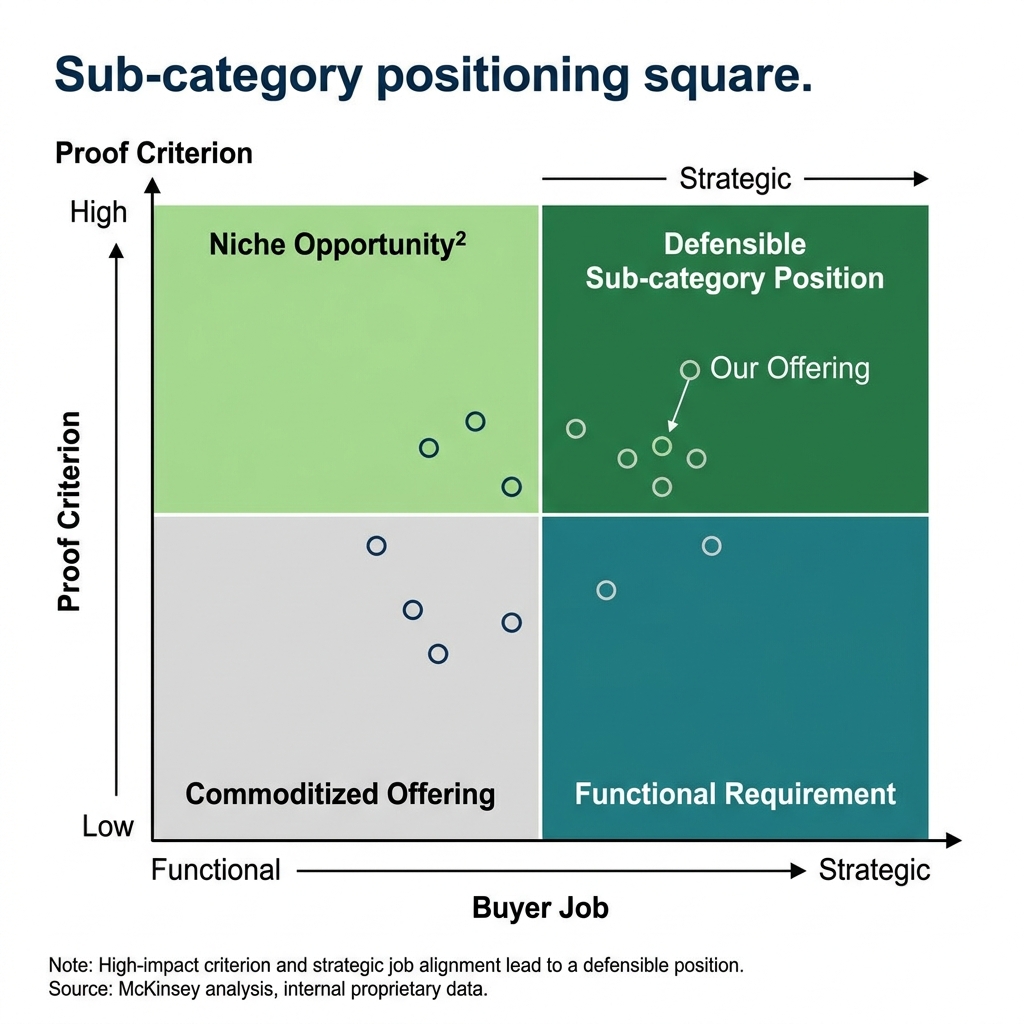 Exhibit: Sub-category positioning square
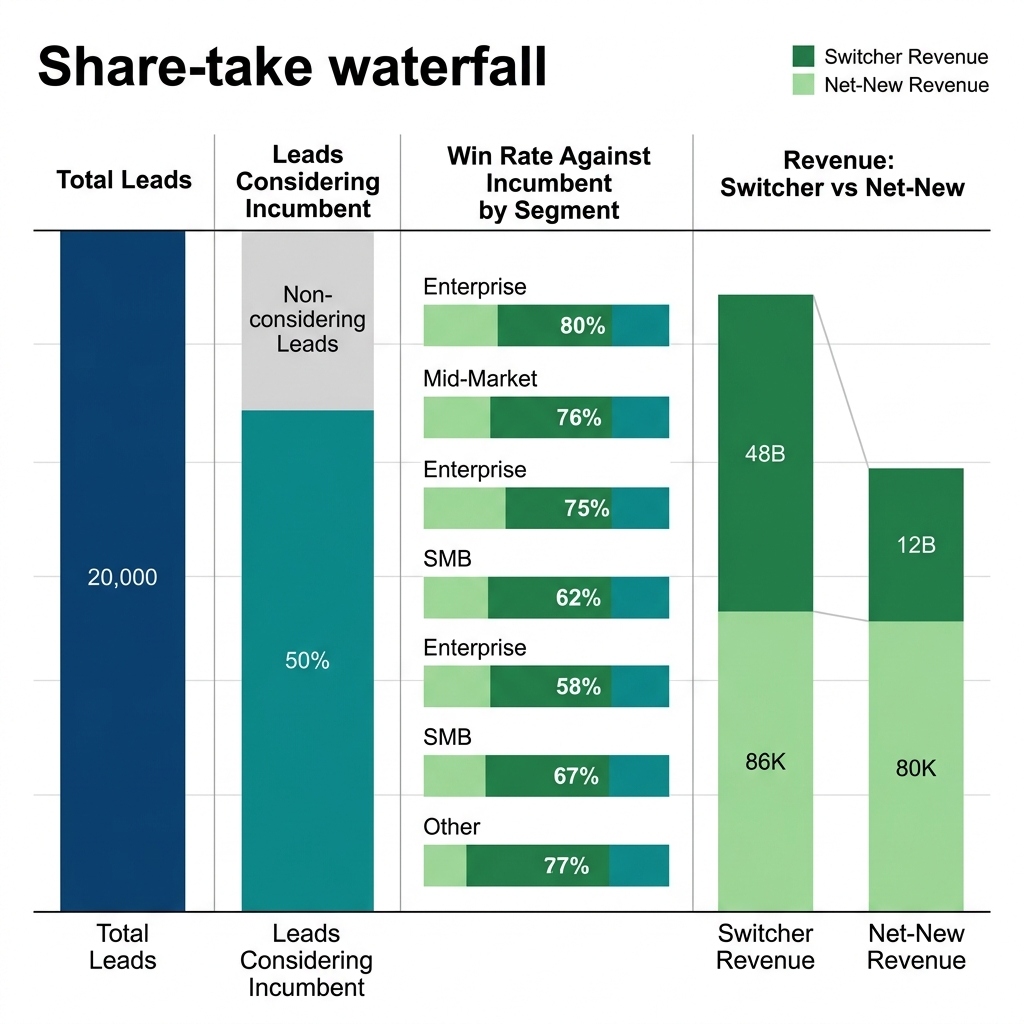 Exhibit: Share-take waterfall
The four-part framework
Four decisions. Each one is a governance decision more than a creative one.
Part 1: Diagnose why the category is flat and who it stopped serving
Flat categories are flat for specific reasons, and the specifics are where the sub-category opening lives. A category stops growing because penetration has maxed out, because the product form has stopped improving, because adjacent categories absorbed the growth, or because the incumbent's value proposition stopped matching a segment of the buyer base. The last of those four is where operators find a carve.
For Bluewave, residential renewable flattened because solar penetration had saturated the suitable-roof segment. The homeowners left were disproportionately on sites where solar underperformed. Shaded lots, coastal exposure, riverfront frontage. The incumbent solar brands had stopped serving that segment well around year eight, because their cost structure and installer network were optimized for easy roofs.
The diagnostic is quantitative. Pull three numbers. First, category growth rate by sub-segment, not the headline rate. Headline 1.7 percent often hides a 5 percent segment and a negative 2 percent segment. Second, incumbent share by sub-segment. The incumbent is almost never equally strong everywhere. Third, buyer dissatisfaction by sub-segment. Bluewave pulled this from discovery call transcripts. The 43 percent "solar did not work for my site" line was a segmentation map disguised as a complaint.
Richard Rumelt in Good Strategy/Bad Strategy called this the diagnosis phase. Most operators skip it because the diagnosis feels slow. The best operators compete on discipline, not instinct, and the discipline here is refusing to move to positioning work until the segmentation numbers tell a story a competitor cannot match.
The output is a one-page segmentation map. Rows are buyer sub-segments. Columns are penetration, incumbent share, and incumbent fit. Your carve is the row where incumbent share is high but incumbent fit is low.
Part 2: Carve a sub-category with a real from/to rather than a new name
A sub-category is defined by a from/to shift in what the buyer uses to evaluate the purchase. Not a new name. Not a new analyst quadrant. A new criterion.
Bluewave tested nine re-anchoring messages. Three held. All three followed the same pattern. From: "which home energy system produces the most kilowatt-hours per dollar of panel." To: "which home energy system produces the most kilowatt-hours on my specific site, across all four seasons." The shift moves evaluation from panel efficiency, where solar wins, to site-specific generation, where tidal and micro-hydro can outperform on unsuitable solar sites.
That is a sub-category. Bluewave still sells in the residential renewable energy category. The evaluation criterion has shifted to ground the incumbent cannot easily play. Solar cannot credibly pivot to "we are the best choice on unsuitable solar sites" without contradicting fifteen years of their own marketing.
April Dunford's move in Obviously Awesome lives here. Positioning is the context you ask the buyer to use when evaluating the product. Change the context and you have changed the product without touching the product.
The from/to must be real in two ways. The buyer must recognize it once they hear it, and the incumbent must be unable to adopt it without cost. If either test fails, it is a tagline, not a sub-category.
Part 3: Re-anchor three evaluation criteria the incumbent cannot credibly match
Three criteria. Not one. Not seven.
One is fragile. A single criterion can be neutralized by the incumbent with a press release and a footnote. Seven is confusion, and confusion is the enemy of willingness to pay. Three is the number of orthogonal claims a buyer can hold in working memory during a comparison.
Bluewave's three held criteria were site-specific generation across seasons, installation survival in high-corrosion coastal environments, and payback period on sites rated low-suitability for solar. Each criterion is measurable. Each criterion is one the solar incumbents cannot publish a counter-number on without admitting their product underperforms on those sites.
The Byron Sharp point from How Brands Grow applies in reverse here. Sharp argued that distinctive assets compound because they are easily recognized and hard to unlearn. The same logic applies to evaluation criteria. If your three criteria are distinctive and hard for the incumbent to copy, they compound. Every comparison a buyer runs reinforces your frame.
Test the three criteria by running them in discovery. If the buyer repeats them back unprompted in later calls, they are holding. If the buyer only uses them when you introduce them, they are not. Kill any criterion that fails the repeat test after 20 calls. Three holding criteria beat five tested ones.
Part 4: Instrument share-take, not category creation
Category creation metrics measure whether the category is growing. Share-take metrics measure whether you are winning from named competitors. In a flat market only the second matters.
The instrumentation is a share-take waterfall by lead source. Column one, total leads. Column two, leads whose prior consideration set included a named incumbent. Column three, win rate against each incumbent. Column four, revenue per install by switcher versus net-new buyer. Bluewave ran this monthly. Their win rate against the three solar incumbents on low-suitability-solar sites climbed from 31 percent to 58 percent over four quarters.
Blended CAC dropped 27 percent, driven by switcher leads arriving pre-qualified through sub-category messaging. Sales cycles compressed 19 percent because the discovery conversation no longer had to reframe the category. The frame arrived with the lead. NPS climbed to plus 41. Bluewave now holds 14 percent share of the coastal low-suitability-solar sub-segment, a segment that did not exist as a line in any analyst report twenty-four months ago.
The board report changed too. Category growth rate came off the cover page. Share-take by named incumbent replaced it.
Three failure modes
Three ways this move dies.
Fake-category-naming. The team invents a new category name, buys an analyst report to place the name on a quadrant, and tells the market the new category exists. The market ignores it because the buyer already has a frame and has no incentive to learn a new one. Money spent on category education flows to the incumbent, because any buyer who reads the new frame and then searches the problem lands on the incumbent's product. Tell: your own sales team does not use the new category name in discovery calls. If the sales team will not say it, the market will not either.
Incumbent-envy positioning. The team positions the product as a better version of the incumbent. Same frame, higher score. This collapses on first contact with the buyer because the incumbent has fifteen years of proof points to cite and you have three. The buyer defaults to the safer choice. Tell: your deck says "like Incumbent but better on X." That sentence is a tombstone for the sub-category move.
Moat-less differentiation. The team picks a criterion the incumbent can adopt in six months. The incumbent adopts it, buys the ad keywords, and closes the gap before the sub-category has time to calcify. Tell: the incumbent's next release notes would credibly close your claim. If so, you do not have a sub-category. You have a feature launch, priced as strategy.
The 30-60-90 sprint
Thirty days: pull the segmentation map. Score category growth, incumbent share, and incumbent fit for every named sub-segment you serve. Record 20 discovery calls. Tag unprompted language. Draft nine candidate re-anchoring criteria and pressure-test each against the incumbent-adoption test.
Sixty days: pick three criteria. Write three positioning statements of twenty words each, one per criterion. Test each statement against fifteen live prospects. Keep the three that produce unprompted repeat language in later calls. Reprice one package 10 to 15 percent above the closest incumbent equivalent to signal premium positioning on the new axis.
Ninety days: rewrite the sales deck to open with the sub-category frame. Retrain every outbound and discovery script around the three criteria. Stand up the share-take waterfall in the CRM. Book the first board review of share gained from named incumbents against the new segmentation map.
The board review at day ninety is the governance checkpoint. If share-take against at least one named incumbent is moving, hold the position for another two quarters. If nothing is moving, return to Part 1 and rediagnose. Do not edit the positioning in month four. Edit the diagnosis.
Exhibits
Exhibit A: the sub-category positioning square. Build a two-by-two. X axis, buyer job, from generic category job on the left to specific sub-category job on the right. Y axis, proof criterion, from incumbent-owned proof at the bottom to sub-category-owned proof at the top. Plot every competitor, including yourself. The quadrant you want is top right.
Exhibit B: the share-take waterfall. Four columns. Total leads by source, leads whose prior consideration set included a named incumbent, win rate against each named incumbent segmented by sub-category fit, revenue per install by switcher versus net-new. Run it monthly for six months before adjusting strategy. The shape that matters is the widening gradient from column one to column three as messaging precision compounds.
Run the free assessment or book a consultation to apply this framework to your specific situation.
References
- Al Ries and Jack Trout, Positioning: The Battle for Your Mind, McGraw-Hill, 1981.
- Geoffrey Moore, Crossing the Chasm, HarperBusiness, third edition 2014.
- Geoffrey Moore, Zone to Win, Diversion Books, 2015.
- April Dunford, Obviously Awesome, Ambient Press, 2019.
- Byron Sharp, How Brands Grow, Oxford University Press, 2010.
- Al Ramadan, Dave Peterson, Christopher Lochhead, Kevin Maney, Play Bigger, HarperBusiness, 2016.
- Seth Godin, This is Marketing, Portfolio, 2018.
- Les Binet and Peter Field, The Long and the Short of It, IPA, 2013.
- Richard Rumelt, Good Strategy/Bad Strategy, Crown Business, 2011.
- Bain and Company, "Consumer Durables Outlook: Navigating Mature Markets," annual industry report.
- McKinsey and Company, "Growth in Mature Markets: Where Incumbents Lose Share," McKinsey Quarterly feature.
- Harvard Business Review, "The Discipline of Category Design," feature article on sub-category strategy in saturated markets.
- Gartner, "B2C Positioning in Saturated Categories," research note on criterion repositioning.
- Forrester, "Share-Take Playbooks for Mature Consumer Hardware Brands," analyst report.
Company names and figures in worked examples are illustrative or changed to protect client confidentiality.
Questions, answered
8 QuestionsHow is category design in a flat market different from Play Bigger-style category creation?
Play Bigger was written for a growth era where the prize was owning an emerging category before anyone else named it. In a flat or declining market the prize is different. You are taking share, not creating market. Naming a new category in a saturated space confuses the buyer because they already have a mental model for the old one. The sub-category move works because it keeps the buyer's existing frame and inserts a specific job your product does better. The work is precision, not invention.
Is a niche the same as a sub-category and should we just go narrow?
Narrow is a starting move, not the end state. A niche is a demographic or vertical slice. A sub-category is a job-to-be-done slice with a real from/to shift in the buyer's evaluation criteria. The difference matters. Niches are defensible by small volume. Sub-categories are defensible by the fact that the incumbent cannot follow without rebuilding their positioning. You want the second kind, because it scales without collapsing when the incumbent notices you.
How do you take share from an incumbent with 10x revenue and 20 years of brand equity?
That is usually the starting condition, not a blocker. Incumbents with long runways have calcified category definitions. They spent years teaching the buyer to evaluate on criteria that suited the incumbent product. Those criteria are now liabilities where the product falls short on newer jobs. Your opening is any criterion the incumbent cannot adopt without contradicting their own marketing. Find three. That is your wedge. You do not fight the incumbent on their category. You change the category so theirs is a sub-segment of yours.
How do you tell whether a sub-category is real or something you made up?
Two tests. First, does the buyer describe the problem in the new frame without being coached? Record 20 discovery calls and count unprompted mentions. If fewer than 30 percent use the new language without prompting, the frame is not landing. Second, does the criterion force a real product trade-off for the incumbent? If the incumbent could adopt your frame in their next release, you do not have a sub-category. You have a feature gap they will close. Real sub-categories force the incumbent to contradict themselves to follow.
How long does it take a re-anchored evaluation criterion to show up in win rates?
Three to six quarters to see reliable signal in discovery calls. Twelve to eighteen months to see it in win rates against the incumbent. Two to three years to see it in category analyst coverage. Most operators kill the move at month nine because the sales cycle data is still noisy. The discipline is to pre-commit the measurement window before the campaign launches. Hold the position through the noise. The incumbents are not repositioning in response. That is the asymmetry you are buying.
What role does pricing play when carving a sub-category in a flat market?
Pricing is a signal before it is a number. In a flat market the buyer reads price as a claim about where you sit. Underprice the incumbent by 20 percent and you are a budget alternative. Match the incumbent and you are a me-too. Price 10 to 15 percent above the incumbent on the axis where you are genuinely superior and you signal a different category entirely. Most founders underprice out of founder anxiety. The sub-category move usually requires a price premium on at least one package, because the buyer needs a signal to match the story.
Do you need a new product to support a sub-category claim, or does packaging hold?
Not always. Usually the product is already 60 to 80 percent of the way there and the positioning has been doing the product a disservice. Repackage before you rebuild. Packaging beats pricing and packaging beats roadmap, because packaging can ship in a quarter and product can take a year. Test the sub-category frame against the existing product. If it holds, the roadmap follows. If it does not hold, you will learn which two or three product gaps are the blockers and you will build those with conviction instead of a 40-item backlog.
What's the most expensive mistake operators make when the category stops growing?
They double down on category awareness spending when category awareness is no longer the bottleneck. If the buyer knows the category exists and has already chosen an incumbent, more category advertising funds the incumbent, not you. The shift is from category education to criterion repositioning. That is a different brief, different creative, different measurement. Most marketing teams do not retool when the category matures, which is why their CAC inflates for two years before anyone names the problem. Confusion is the enemy of willingness to pay, and running a land-grab playbook in a mature market is the most expensive kind of confusion.
When the category stops growing, the playbook flips. You do not create a new category. You carve a defensible sub-category inside the old one, re-anchor the buyer's evaluation criteria on ground the incumbent cannot occupy, and instrument share-take rather than category creation. This is offensive repositioning against competitors with a decade of head start.
How relevant and useful is this article for you?
About the Author(s)
 Emily Ellis is the Founder of FintastIQ. Emily has 20 years of experience leading pricing, value creation, and commercial transformation initiatives for PE portfolio companies and high-growth businesses. She has previous experience as a leader at McKinsey and BCG and is the Founder of FintastIQ and the Growth Operating System.
Further reading
- Al Ramadan, Dave Peterson, Christopher Lochhead & Kevin Maney. Play Bigger. HarperBusiness, 2016
- April Dunford. Obviously Awesome. Page Two, 2019
- Al Ries & Jack Trout. Positioning. McGraw-Hill, 2001
- Al Ries & Jack Trout. The 22 Immutable Laws of Marketing. HarperBusiness, 1994
- Clayton M. Christensen, Scott Cook & Taddy Hall. Marketing Malpractice: The Cause and the Cure. Harvard Business Review, 2005