
Seven Channels, One Brand, Six Months of Drift Each Time
A single brand voice is not a tagline and a color palette. It is a messaging architecture. Shared asserts that every channel carries. Channel-specific proof points that each channel is licensed to own. A review cadence that catches drift in 30 days rather than 6 months. The operating discipline that keeps a heritage brand coherent when it sells through seven channels, three sub-brands, and a wholesale book of 900 accounts.

The Operator's Guide to Messaging Architecture for Cross-Channel Teams
Your marketing team wrote a manifesto. Your DTC copywriter ignored it. Your wholesale rep ignored it harder. Your designer sell-in lead wrote her own. Six months later the brand means seven different things.
You do not have a brand problem. You have an architecture problem.
TL;DR.
- A brand voice that is a manifesto without enforcement will drift across channels inside 6 months. It always does, because channel managers ship daily and the manifesto shipped once.
- The fix is a messaging architecture with two layers. Shared asserts every channel is required to carry. Channel-specific proof points each channel is licensed to own. One layer without the other fails.
- The review cadence matters as much as the document. Monthly audit for active channels, quarterly working session with channel managers, drift-detection scorecard tied to a date field.
- Measure message-market-fit per channel, not aggregate brand awareness. Aggregate numbers hide the drift that per-channel numbers expose.
- Confusion is the enemy of willingness to pay. A coherent architecture protects price signal across channels more reliably than any guideline document ever has.
The core problem: the manifesto does not ship the channel
Meet Harrow & Hollin Mills. 90 years old, a British heritage textile manufacturer with a mill on the edge of the Pennines. 160 people. $58M revenue. Three revenue channels. 28 percent DTC e-commerce, selling finished fabrics to home sewists and quilters. 52 percent independent wholesale, 900 accounts, mostly haberdashers, quilt shops, and small garment makers scattered across the UK, Europe, and North America. 20 percent B2B designer-supply, selling couture-weight fabric to 12 premium fashion houses on annual supply contracts.
Three sub-brands sit inside the master brand. A heirloom quilting cotton line. A garment-maker worsted wool line. A designer-only couture line that only appears in sell-in lookbooks, never on the DTC site.
Ottilie runs marketing. When she arrived, she found 7 channel messaging guides. DTC copy had one voice. Email another. Paid social a third. The wholesale catalog spoke like a trade publication from 1994. The designer lookbook read like a Vogue editorial. Retail POS materials used language the wholesale accounts did not use with their own customers. Owned editorial contradicted the DTC site on whether the mill was a heritage maker or a modern craft workshop.
None of the 7 guides was wrong in isolation. Stitched together, the brand was incoherent. A haberdasher who stocked the quilting line and read the designer lookbook at a trade fair could not explain what business Harrow & Hollin was actually in.
Ottilie's board asked for a rebrand. She pushed back. A rebrand refreshes the visual identity and leaves the architecture problem in place. The brand did not need a new logo. It needed a contract about what every channel was allowed to say.
The best operators compete on discipline, not instinct. The discipline here is architecture. What follows is the four-part framework Ottilie used to collapse 7 channel messaging guides into 1 unified architecture with 19 shared asserts and 34 channel-specific proof points, and the commercial outcomes that followed.
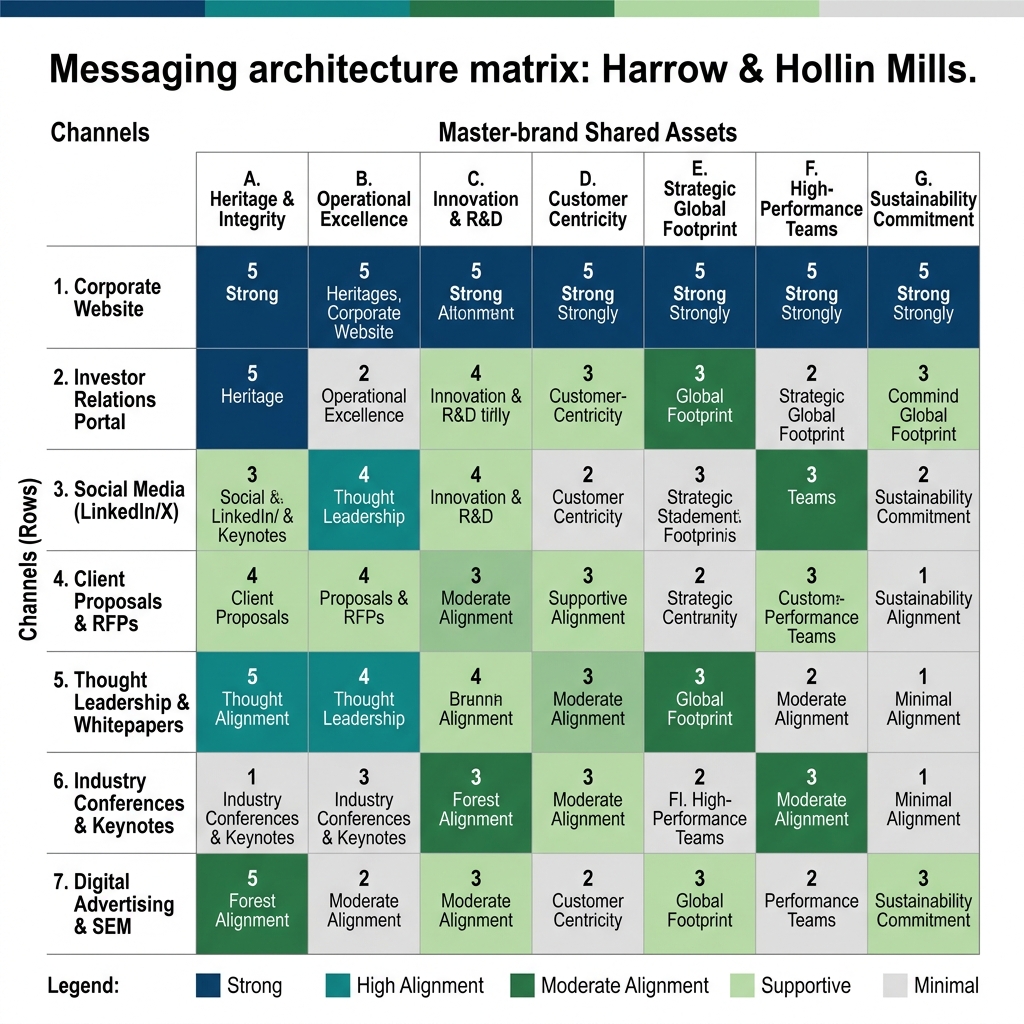 Exhibit: Messaging architecture matrix
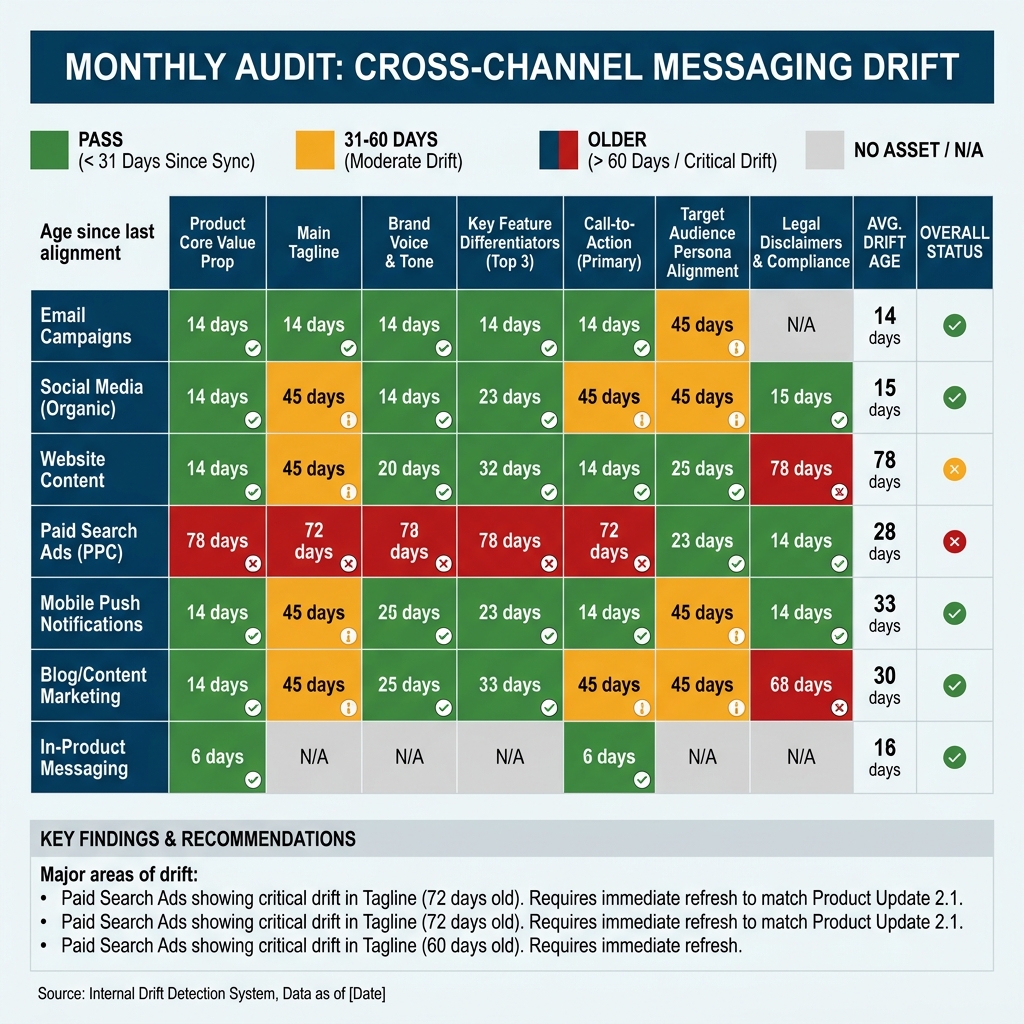 Exhibit: Drift-detection scorecard
The four-part framework
Four decisions, in order. Skip one and the architecture becomes a deck.
Part 1: Decide the shared asserts
The shared asserts are the 7 to 9 claims that every channel is required to carry. Not preferred. Required. They are the brand's load-bearing sentences, the ones that define what it is for and what it is not.
At Harrow & Hollin Mills, Ottilie ran a three-week exercise. She interviewed 14 customers across the three channels, reviewed two years of press coverage, pulled designer-channel sales calls, and asked the master weaver, 38 years at the mill, to describe the work.
The list emerged at 34 candidates. She cut to 19 shared asserts across the master brand and the 3 sub-brands combined. The master brand carried 7 shared asserts. The three sub-brands each carried 3 to 4 specific to their product world but non-negotiable inside it.
Examples at the master-brand level. The mill has woven continuously on the same site since 1934. Every fabric is finished in the UK. The dye house runs on rain-harvested water from the Pennines. The company is independent and family-held across three generations. Each assert failed the competitor-copy test cleanly, because they were facts about a specific mill, not claims a competitor could replicate with a press release.
The test for a shared assert is mechanical. Is it true across every channel? Would removing it change what the brand means? Can a customer who hears only this sentence place the brand correctly in its category? Three yes answers makes it a shared assert. Any no and it belongs in the second layer.
Packaging beats pricing. The shared asserts are the packaging of the brand itself. They are the architecture of what the brand is, before any channel translates that architecture into a sentence, an image, or a price.
Part 2: License channel-specific proof points
The second layer is the one most architectures miss. Shared asserts alone produce a brand that sounds the same everywhere, which is a brand that sounds like nowhere. Lowest-common-denominator messaging is the failure mode of the manifesto-only approach.
Channel-specific proof points are the claims each channel is licensed to own that the other channels do not carry. Each channel picks 2 to 3. They are permitted, not required, for that channel, and they are explicitly unavailable to the others.
At Harrow & Hollin Mills, 34 channel-specific proof points were licensed across 7 channels. DTC owned home-use instructions, finished-project inspiration, and direct-from-mill pricing. Email owned the master weaver's personal voice, behind-the-scenes mill content, and early access to limited runs. Paid social owned color stories, seasonal trend framing, and user-generated content. Wholesale owned margin math, exclusive SKUs by account tier, and the 900-account network as a badge of trade credibility. Designer-supply owned named fashion houses on the client roster, hand-loom capacity for couture runs, and the private archive accessible by appointment. Retail POS owned care instructions on physical tags and end-use photography. Owned editorial, the quarterly magazine, owned regional textile heritage, long-form profiles of independent makers, and the mill's role in the Pennine economy.
The licensing is deliberate. The designer channel does not talk about direct-from-mill pricing, because using a DTC proof point in sell-in cheapens the tier. The DTC site does not name the fashion houses, because that would breach a contractual confidentiality and dilute exclusivity. The wholesale catalog does not run the master weaver's personal voice, because it reads wrong in a trade catalog.
Pricing is a signal before it is a number. The channel-specific proof points protect the price signal by making each channel legible to its specific audience without letting one channel's proof points leak into another's pricing context.
Part 3: Establish a review cadence that catches drift in 30 days
An architecture without a review cadence is a document. A document does not ship the channel.
Ottilie built a three-tier cadence. The monthly audit is a 30-minute review of the previous month's top 10 assets per channel, scored against a drift-detection scorecard. One reviewer, one scorecard, one list of exceptions. The scorecard has three columns. Did the asset carry at least 3 of the required shared asserts? Did the asset use only licensed proof points for its channel? Is the asset's last-review date within the 30-day window? A single miss on any column is a drift exception.
The quarterly working session is 90 minutes with all channel managers present. Drift exceptions from the monthly audits are reviewed in aggregate. Channel managers can challenge an assert that consistently fails in their channel. If a proof point has not been used in 90 days, the license is reviewed. The session is for architecture updates, not for defending past drift. Past drift is closed by the monthly audit.
The annual recalibration is the structural review. Is the architecture still correct? Has a channel changed enough to need a different proof-point license? Has a new channel been added that needs its own license negotiated? This is the only session at which shared asserts are revisable. Between annual reviews, shared asserts are fixed.
At Harrow & Hollin Mills, the 30-day cadence caught drift in three channels within the first quarter of operation. The paid social channel was running a summer campaign that used a designer-channel proof point it did not have a license for. The wholesale catalog had dropped two shared asserts to save copy-space. The email program had invented a new proof point nobody had authorized. Each was corrected in the following monthly cycle. None reached the annual review. Under the previous regime, each would have run unchallenged for 6 to 9 months.
Part 4: Measure message-market-fit per channel, not aggregate brand awareness
Aggregate brand awareness is the measure that hides the drift. A brand can hold its awareness number while three of its seven channels drift underneath the number, because the drift averages out. The aggregate number tells you the brand is fine. The per-channel number tells you two channels are bleeding.
Message-market-fit per channel is a 4-question quarterly survey run against customers of each channel independently. Did the customer understand what the brand was for within the first two touchpoints on this channel? Could the customer describe the brand in a sentence after three visits? Did the customer's description match the channel's shared asserts? Did the customer cite any of the channel's licensed proof points?
At Harrow & Hollin Mills, the first quarter of per-channel measurement exposed that designer-channel customers understood the brand 31 points better than DTC customers. Not because DTC customers were slower. Because the DTC messaging was diluted across too many proof points and not enough shared asserts. The architecture correction redistributed proof-point emphasis inside the DTC channel and produced a 14 percent DTC AOV lift within three quarters, a 23 percent compression in the wholesale re-order cycle, and a 41 percent engagement lift on designer-channel content.
Confusion is the enemy of willingness to pay. Per-channel message-market-fit measures the confusion. Aggregate awareness does not.
Where this framework breaks: three failure modes
Failure one: manifesto without enforcement. Marketing writes a beautiful brand manifesto, circulates it to the channel managers, and never audits whether it ships. Three months in, the manifesto is a PDF in a shared drive. Six months in, each channel has reverted to the voice it had before the manifesto. Fix: no manifesto without a monthly audit and a named reviewer. The audit is the enforcement. Without it the manifesto is an unfunded mandate.
Failure two: lowest-common-denominator messaging. The architecture is all shared asserts, no channel-specific proof points. Every channel reads the same, so no channel reads as native to its audience. The DTC customer bounces because the site sounds like a trade catalog. The designer buyer ignores the sell-in deck because it sounds like DTC marketing. Fix: the proof-point licensing is not optional. A channel that carries only shared asserts is a channel that cannot speak to its audience in that audience's language. Packaging beats pricing, and the proof points are the channel-specific packaging.
Failure three: the channel manager as ghostwriter. No architecture exists, so each channel manager writes what they think the brand should sound like. Over time the brand becomes the sum of whoever happens to be in seat. When the channel manager leaves, the voice leaves with them. Fix: the architecture has to exist before the channel manager is hired, and the job description has to specify carrying the architecture rather than inventing the voice. The channel manager's creative contribution is inside the licensed proof points, not outside the shared asserts.
The 30-60-90 sprint for messaging architecture
Days 1 to 30. Audit the current state. Collect every channel messaging guide, every recent campaign asset, every sales deck, every email template, every press hit. Score each against an open question. Does this asset agree with every other asset on what the brand is for? Interview 10 to 15 customers across channels. Ask them to describe the brand in a sentence. Record the deltas. At Harrow & Hollin Mills, 7 guides produced 7 different sentences. The audit is the business case for the architecture.
Days 31 to 60. Draft the architecture. Build the candidate list of shared asserts. Cut to 7 to 9 at the master-brand level. Add sub-brand asserts if the business has sub-brands. Draft the channel-specific proof points for each channel, limited to 2 to 3 per channel. Run the competitor-copy test on every assert and proof point. Workshop the architecture with one channel manager per channel before opening it to the full team. The first workshop surfaces the disagreements. Resolve them before the second round.
Days 61 to 90. Launch the cadence and the scorecard. Publish the architecture. Build the drift-detection scorecard. Assign the monthly reviewer. Run the first monthly audit in week 12. Schedule the first quarterly working session for day 90. Publish the per-channel message-market-fit survey. The sprint does not finish the architecture. It installs the operating discipline that the architecture will run under for the next 24 months.
Run the free assessment or book a consultation to apply this framework to your specific situation.
References
- Dunford, April. Obviously Awesome: How to Nail Product Positioning so Customers Get It, Buy It, Love It. Ambient Press, 2019. On the single-sentence position test and the relationship between positioning and channel messaging.
- Sharp, Byron. How Brands Grow: What Marketers Do not Know. Oxford University Press, 2010. On distinctive brand assets, mental availability, and the requirement for consistent cross-channel signals.
- Binet, Les, and Peter Field. The Long and the Short of It: Balancing Short and Long-Term Marketing Strategies. IPA, 2013. On the compounding window for brand signals and the measurement lag that hides drift in aggregate numbers.
- Godin, Seth. This Is Marketing: You Cannot Be Seen Until You Learn to See. Portfolio, 2018. On the smallest viable audience and the channel-native voice required to reach them.
- Godin, Seth. Purple Cow: Transform Your Business by Being Remarkable. Portfolio, 2003. On remarkable versus average in saturated categories and the role of channel-specific proof points in producing remarkability.
- Ries, Al, and Jack Trout. Positioning: The Battle for Your Mind. McGraw-Hill, 2001 edition (orig. 1981). Canonical on category rank and the need for a coherent position held across every channel the brand appears in.
- Neumeier, Marty. The Brand Gap: How to Bridge the Distance Between Business Strategy and Design. New Riders, 2005. On the operational gap between brand strategy and channel execution, which the messaging architecture is designed to close.
- Olins, Wally. Brand New: The Shape of Brands to Come. Thames & Hudson, 2014. On heritage brand management, sub-brand architecture, and the governance disciplines required to keep multi-channel brands coherent.
- Harvard Business Review. "How to Build a Strategic Brand Architecture." Harvard Business Review, 2020. https://hbr.org/2020/09/a-better-way-to-map-brand-strategy (on the two-layer logic of master brand and sub-brand asserts).
- McKinsey & Company. "The Omnichannel Consumer: How Retailers Can Win in a Multi-Channel World." https://www.mckinsey.com/industries/retail/our-insights/the-state-of-grocery-retail-navigating-uncertainty-while-transforming-for-growth (on multi-channel consumer behavior and the coherence premium across DTC, wholesale, and retail).
- Kantar. "BrandZ: The Most Valuable Global Brands Report." https://www.kantar.com/campaigns/brandz (on cross-channel brand measurement and the per-channel salience metrics that replace aggregate awareness).
- WARC. "Multi-Channel Messaging: How Heritage Brands Maintain Coherence Across Distribution." https://www.warc.com (on heritage-brand case practice in retaining voice across DTC, wholesale, and B2B channels).
- Business of Fashion. "The State of Fashion 2025: Brand Coherence in a Fragmented Retail Landscape." https://www.businessoffashion.com/reports/news-analysis/the-state-of-fashion-2025-report-bof-mckinsey/ (on heritage fashion and textile brand management under multi-channel pressure).
- Simon-Kucher. "Global Pricing Study 2025." 2025. https://www.simon-kucher.com/sites/default/files/media-document/2025-05/Simon-Kucher_State%20of%20Pricing%202025.pdf (on the relationship between messaging coherence and pricing power across channels).
Company names and figures in worked examples are illustrative or changed to protect client confidentiality.
Questions, answered
8 QuestionsWhat's the difference between a messaging architecture and brand guidelines?
Brand guidelines cover logo, palette, typography, and tone. A messaging architecture covers claims. It names the 7 to 9 shared asserts every channel is required to carry, the channel-specific proof points each channel is licensed to own, and the review cadence that keeps the two layers in sync. Guidelines tell the designer which green is correct. Architecture tells the wholesale rep, the DTC copywriter, and the designer sell-in lead what the brand is allowed to say this quarter and what it is not.
How many shared brand asserts is the right number for a multi-channel team?
Seven to nine. Fewer than 7 and the architecture is too thin to differentiate the brand across channels. More than 9 and channel managers cannot remember them, so they carry the two they prefer and drop the rest. At Harrow & Hollin Mills we landed on 19 shared asserts across the master brand and 3 sub-brands combined, which averages roughly 6 per sub-brand plus the master. Test the count by asking a channel manager to recite them from memory. If they cannot, the architecture is already decorative.
How do you tell when a channel's messaging has drifted from the brand architecture?
Three signals. First, a channel manager writes copy that contradicts a shared assert outright. Second, two channels describe the same product benefit in incompatible terms. Third, a customer who shops across two channels tells you they thought the two were different brands. The third signal is the trailing indicator. By the time a customer says it, the drift has been running for 4 to 6 months. The architecture review cadence is designed to catch the first two signals before the third one lands.
How often should a CMO audit channel messaging against the brand architecture?
Monthly for active campaigns, quarterly for evergreen assets, and at every new channel launch. The monthly cadence is a 30-minute audit, not a committee. One reviewer, one scorecard, one list of drift exceptions. The quarterly cadence is a 90-minute working session with channel managers present. Annual brand reviews are too infrequent for modern channel velocity. A social calendar can drift in 6 weeks. An annual review finds the drift after three quarters of damage.
What do you do when a channel manager pushes back on the shared brand asserts?
Pushback is useful signal. Treat it as a hypothesis that the assert is wrong or the proof point is weak, not as insubordination. The architecture is not a gag order. It is a shared contract. If the channel manager for wholesale says the fourth shared assert does not land with haberdashers, that is a data point worth a working session. Revise the assert or retire it. What you cannot allow is a channel manager ignoring the architecture quietly, because that is how brands end up meaning seven different things to seven different audiences.
Does messaging architecture apply to single-channel DTC brands or only multi-channel?
Partially. Single-channel DTC brands still face drift across email, paid social, organic social, site copy, and packaging voice. The shared asserts and proof-point licensing still apply. The review cadence can be lighter because there are fewer channel managers and the feedback loop is shorter. The full architecture becomes essential when a brand adds a second channel with a distinct audience, which is when the first drift episode usually shows up 6 months after wholesale launches.
How does cross-channel messaging architecture protect pricing power?
Directly. A channel that drifts on messaging drifts on price signal. If your DTC copy positions the brand as everyday craft and your designer sell-in deck positions it as rarefied mill heritage, the two price points look like a pricing mistake rather than an intentional channel ladder. Pricing is a signal before it is a number. The architecture is the thing that keeps the signal coherent across channels so the number lands where you set it.
How do you measure whether a messaging architecture is actually working?
Three measures. First, a drift-detection scorecard that tracks how many channel assets last quarter carried the required shared asserts. Second, channel-level message-market-fit scores, which are a 4-question customer survey run per channel per quarter, not aggregate brand awareness. Third, the commercial outcome. At Harrow & Hollin Mills the architecture correlated with a 41 percent engagement lift on designer-channel content, a 23 percent compression in the wholesale re-order cycle, and a 14 percent DTC AOV lift over the following three quarters.
A single brand voice is not a tagline and a color palette. It is a messaging architecture. Shared asserts that every channel carries. Channel-specific proof points that each channel is licensed to own. A review cadence that catches drift in 30 days rather than 6 months. The operating discipline that keeps a heritage brand coherent when it sells through seven channels, three sub-brands, and a wholesale book of 900 accounts.
How relevant and useful is this article for you?
About the Author(s)
 Emily Ellis is the Founder of FintastIQ. Emily has 20 years of experience leading pricing, value creation, and commercial transformation initiatives for PE portfolio companies and high-growth businesses. She has previous experience as a leader at McKinsey and BCG and is the Founder of FintastIQ and the Growth Operating System.
Further reading
- April Dunford. Obviously Awesome. Page Two, 2019
- Donald Miller. Building a StoryBrand. HarperCollins Leadership, 2017
- Al Ries & Jack Trout. Positioning. McGraw-Hill, 2001
- Al Ramadan, Dave Peterson, Christopher Lochhead & Kevin Maney. Play Bigger. HarperBusiness, 2016
- Clayton M. Christensen, Scott Cook & Taddy Hall. Marketing Malpractice: The Cause and the Cure. Harvard Business Review, 2005