
Private Label Cut 30%. You Cut 12%. You Just Lost the Position.
Positioning is not a messaging exercise. It is an operating decision about where you win, who you fight, and what you refuse to do. When the category commoditizes, most brands react by cutting price. The good ones name their next position before the market names them out of it.

The Operator's Guide to Positioning Under Pressure
Private label undercut you by 30 percent last quarter. You cut your price 12 percent. You are now losing money at a position you no longer own.
Ries and Trout published Positioning in 1981 and the core argument has not aged. The mind of the customer organizes brands by category and rank. When you lose the rank, the moves are to create a new category, redefine the old one, or accept decline. Most brands pick a fourth option that does not exist. They discount through the commoditization cycle and call it a response.
It is not a response. It is being renamed by the market.
Simon-Kucher's 2025 Global Pricing Study puts the number at 65 percent. Only 65 percent of companies truly possess pricing power. The other 35 percent are price takers who call themselves premium.
TL;DR.
- Positioning has a shelf life. The position that made you famous is the first thing that dies when the category commoditizes, a lower-cost entrant arrives, or a retailer private-labels your shelf. Discounting extends the decline. It does not reverse it.
- Four decisions, in order. Name your current position in one sentence. Map the pressure vectors. Identify the position the competitor cannot copy. Sequence the repositioning runway. Skip any one and you ship a rebrand instead of a reposition.
- This paper is the operating discipline for naming your next position before the market names you out of it. It is not a messaging exercise. It is a commercial one, with 40 points of margin riding on the outcome.
The core problem
Positioning has a shelf life, and operators who pretend it does not lose 40 or more points of margin in a commoditization cycle. The position you held three years ago was a consequence of a specific competitive context. When the context shifts, the position softens. Existing customers do not churn on the day the category moves. Then CAC drifts. Then wholesale conversations get harder. Then the retailer asks about a lower opening price.
By the time the P&L reflects the shift, the position has been gone for six to nine months.
Meet Orbit & Oak. 55 people, $14M revenue, DTC premium pet food. Small-batch, locally-sourced protein. Paid-search-driven DTC base plus 110 specialty pet retailers wholesale. Customers paid a 45 percent premium over commodity kibble and gross margin cleared 52 percent.
Two of the three national big-box pet retailers launched private-label "artisan" lines at a 32 percent lower shelf price. The packaging looked similar. The ingredient decks read similar. The big-box buyer told the Orbit & Oak sales team the shelf set was being rationalized and the brand would need to hit a new opening price to stay on plan.
Orbit & Oak lost 18 percent of wholesale revenue in two quarters.
The founder, Hana, modeled a 15 percent retailer price cut and a 10 percent DTC promotion. The numbers penciled if DTC volume grew 25 percent. It grew 6 percent. Paid-search CAC rose 22 percent over the same period because every small premium pet brand was bidding on the same keywords and the category was eating itself.
The price cut did not defend the position. It confirmed the commoditization. Pricing is a signal before it is a number. A 15 percent cut told the customer that Orbit & Oak was the same product as the private label with a legacy premium. The signal broke the brand before the math did.
The better move was a reposition around veterinary provenance, which the private label could not fake in 18 months.
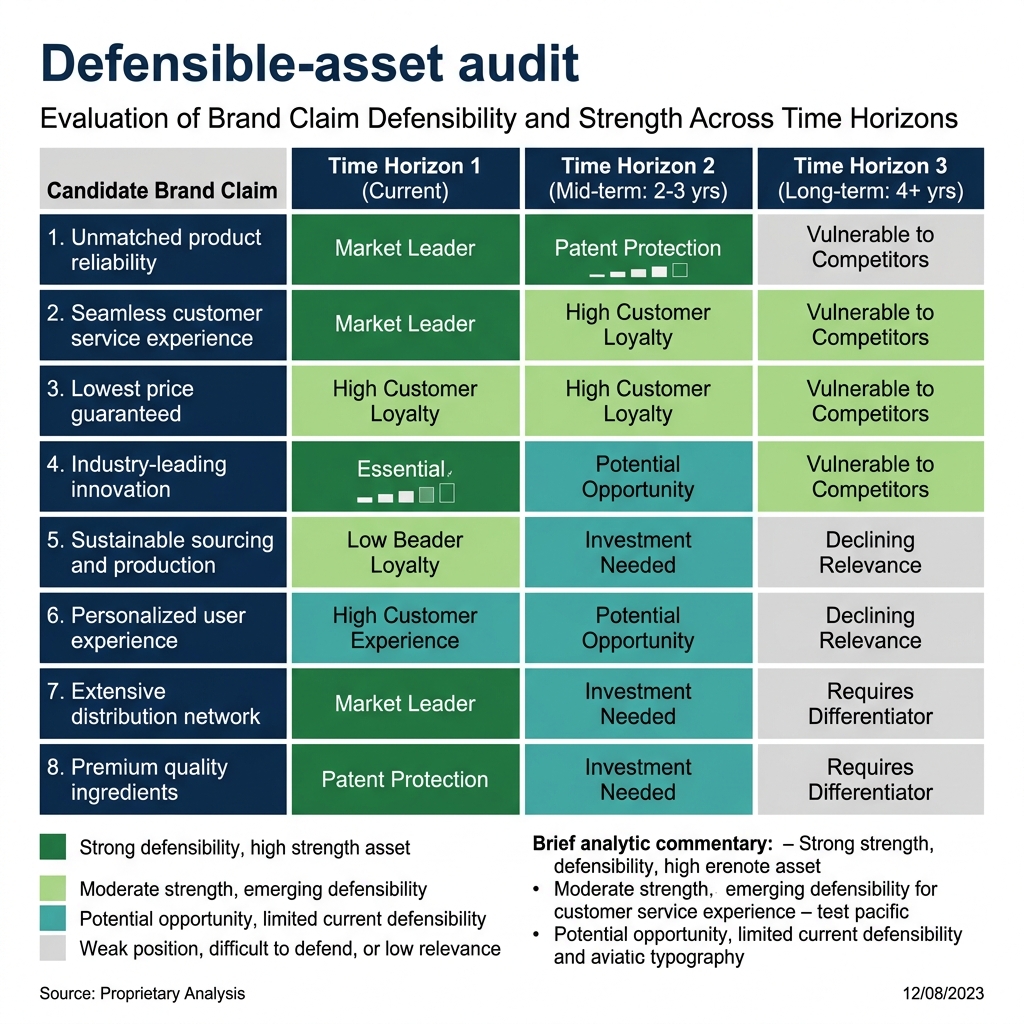 Exhibit: Defensible-asset audit matrix
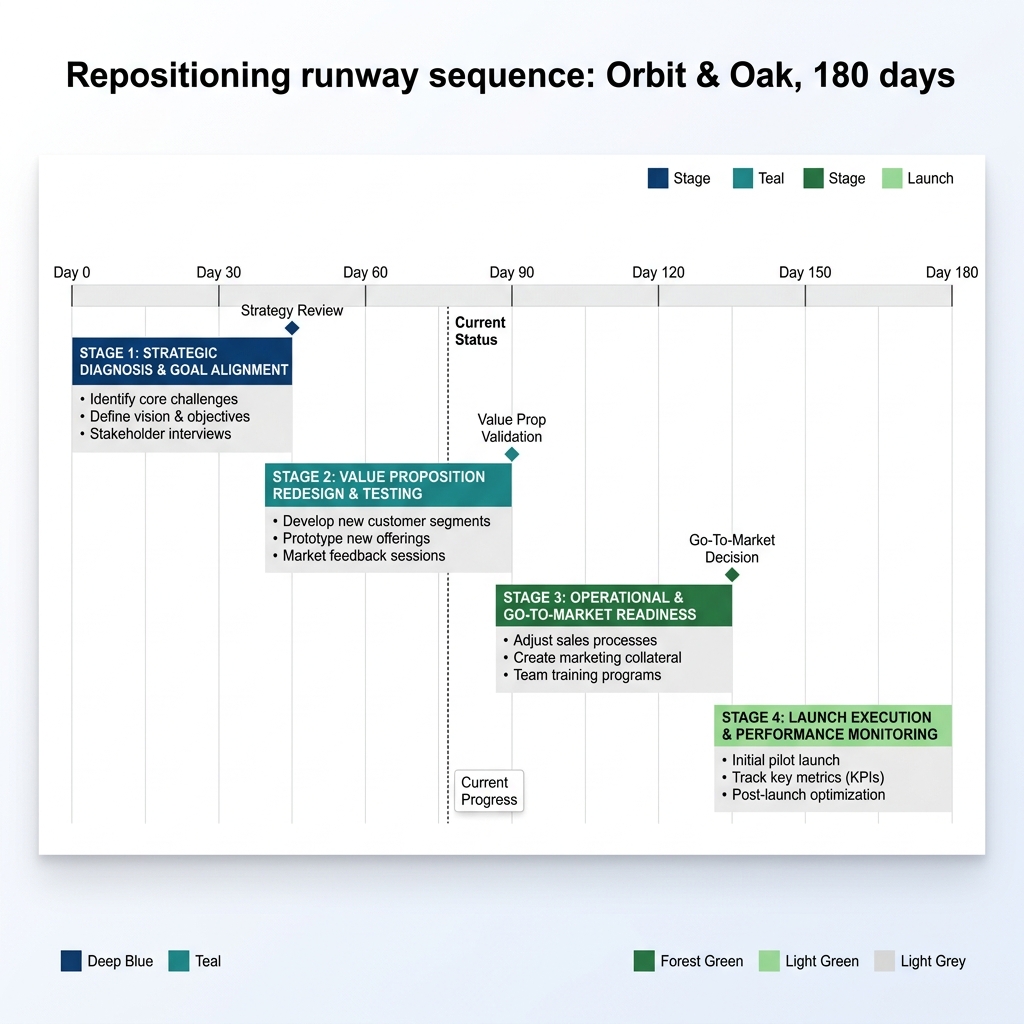 Exhibit: Repositioning runway sequence
The four decisions a repositioning makes before the launch ships
Four decisions, in order. Skip any one and the repositioning becomes a rebrand.
Decision 1: Name your current position in one sentence
Before you reposition, name the position you are actually in. Not the one on the website. Not the one in the deck. The one the customer holds in their head when your brand shows up on the shelf.
April Dunford's test in Obviously Awesome and Sales Pitch is the useful one. In one sentence, name the alternative you beat, the segment that cares most, and the unique value you deliver against that alternative. If you cannot write the sentence, you do not have a position. You have a brand personality.
Run the test with two people. The CRO writes the sentence. The VP Marketing writes the sentence. Separate rooms. If the sentences do not match, the position does not exist. It is a slide in a deck the two of them read at different times.
Hana ran the test at Orbit & Oak. The CRO wrote "Orbit & Oak is for pet owners who care about ingredient quality and are willing to pay a premium." The VP Marketing wrote "Orbit & Oak is the small-batch artisan pet food that treats your dog like family." Same brand. Different positions. One is a value prop for a commodity category. The other is a lifestyle claim for a saturated one. The private label could copy both in a quarter.
The goal is not alignment. It is to surface the fact that the position drifted, nobody noticed, and two senior leaders have been selling two different stories for eighteen months. The repositioning cannot start until you name the actual current position out loud.
Decision 2: Map the pressure vectors
Once you have named the position, map the forces pressing against it. Four vectors show up repeatedly. Name the ones that apply to your category.
Private label. A retailer copies your category and undercuts your shelf price. Distribution leverage, no customer acquisition cost. You cannot out-cheap or out-distribute them.
New entrant. A well-funded brand enters with a sharper story or lower cost structure. Often DTC native, narrower product set. They win on focus and novelty. They do not win on your installed base unless you let them.
Category decline. The job your category was hired for is being replaced by an adjacent category. Pet owners moving from kibble to fresh-frozen. The category shrinks and every incumbent fights for a smaller pool.
Substitute. A different category solves the same job better. Meal delivery for pets. Vet-subscription models that include food. It is not a competitor in your category. It is a category that eats yours.
Orbit & Oak had two active vectors. Private label from the big-box retailers, pressing on the wholesale book. Substitute from fresh-frozen subscription brands, pressing on the DTC base from a different direction. A response to one does not automatically address the other.
Ries and Trout in Marketing Warfare argue that the first decision in any defense is to name the attacker correctly. A defense against a flanking attack does not work against a frontal one. Most brands pick the wrong war because they feel pressure and assume competition. The pressure has a shape. Find the shape first.
Decision 3: Identify the position the competitor cannot copy
The best repositioning is to a place the competitor cannot follow. Byron Sharp in How Brands Grow frames this as the distinctive-asset portfolio. What assets does your brand own that a competitor cannot replicate inside three years without rebuilding their business model?
Run a defensible-asset audit. List every claim. For each, ask three questions. Could the competitor add this claim to their website in 30 days? Could they add it in 12 months with a supplier change? Or would they have to rebuild their supply chain, earn a credential, or change their cost structure? Only the third answer is defensible.
Orbit & Oak ran the audit across eight candidate claims. Small-batch, locally-sourced, human-grade, high protein ratio, clean label, vet-formulated, veterinary-clinic distribution, breed-specific formulations.
Six failed. The big-box private label could match small-batch, locally-sourced, human-grade, protein ratio, and clean label inside a year with a supplier change and a press release. Most already had.
Two passed. Vet-formulated, because it required a credentialed veterinary nutritionist on staff and a clinical trial protocol the private label was not willing to fund. Veterinary-clinic distribution, because it required multi-year relationships with independent vet practices and a regulated product claim the big-box retailer could not negotiate with a signed PO.
Those two assets were the next position. "The pet food veterinarians formulate and carry." That sentence failed the competitor-copy test for the private label and passed it for the DTC substitute. It addressed both pressure vectors with one structural move.
Al Ramadan in Play Bigger calls this category design. The best defense in a commoditizing category is to create a new category adjacent to it, where you are the defining brand. The veterinary positioning created a sub-category Orbit & Oak could own. The big-box private label could not enter it without surrendering the cost advantage that made them competitive.
Packaging beats pricing. In a repositioning, the packaging is the brand itself. The architecture of what you sell, who you sell to, and how you credential the claim is the load-bearing decision. The price adjusts to the architecture.
Decision 4: Sequence the repositioning runway
The fourth decision is the one most brands fumble. They pick a new position and launch it across every channel on day one. The website changes. The ads change. The sales deck changes. The retail shelf does not change for six months because retail resets run on a calendar the brand does not control. The customer sees a new website and an old shelf and assumes the brand is confused. Confusion is the enemy of willingness to pay.
The runway has four stages.
Stage one. Proof points. Before any brand signal changes externally, the organization produces the evidence. Clinical data. Credentialing. Case studies. Customer interviews. The proof points have to exist before the claim lands, or the claim reads as marketing. Orbit & Oak commissioned a clinical trial with two independent veterinary clinics, hired a board-certified veterinary nutritionist as the named formulator, and built a cohort of vet-recommended customer stories.
Stage two. Sales enablement. Before marketing launches externally, the sales team is retrained. New deck. New objection handling. New price book that reflects the repositioned tier. Geoffrey Moore in Crossing the Chasm is direct on this. A position shift that does not show up in the sales conversation first dies in the first quarter of external launch, because the sales team keeps selling the old position while marketing sells the new one.
Stage three. Brand signals. New packaging. New website. New category claim. This is the visible layer and it comes third, not first. Binet and Field in The Long and Short of It argue that brand signals compound over 12 to 18 months. The launch is the start of the compounding, not the event that produces the revenue.
Stage four. Distribution realignment. Wholesale, retailer relationships, and DTC acquisition channels realign to the new position. Some relationships do not survive it. At Orbit & Oak, 22 of the 110 specialty pet retailers did not renew under the veterinary positioning. The remaining 88 deepened order commitments by an average of 18 percent, and 41 new veterinary-clinic accounts signed in the first year. Net wholesale revenue grew 14 percent on a smaller retailer count. Higher margin, tighter fit.
Seth Godin in Purple Cow and This Is Marketing frames this as choosing the smallest viable audience. The reposition intentionally narrows the market. The narrowing is the point. A position that serves everyone is the position the private label just took from you.
Where this framework breaks
Three failure modes. Each costs real money.
Failure one: the rebrand-as-reposition fallacy. A brand hires a design agency, refreshes the logo and palette, and launches a new campaign. No change to the target customer, no change to the defensible asset, no change to the pressure-vector response. Six months later CAC is the same, the wholesale book is the same, and the private label is still winning on shelf. The rebrand burned $800,000 and bought no structural change. Fix: run the competitor-copy test on the new claim before the design work starts. If the competitor can match it in 90 days, the rebrand is lipstick on a lost position.
Failure two: the sales team still selling the old position. Marketing launches the new position in Q2. The sales team, whose comp plan was built around the old SKU mix, keeps selling the old story because the old story hits quota. Six months in, the website says one thing, the reps say another, and the retailer buyer calls it out in a QBR. The position dies in the sales call, not the marketing channel. Fix: reposition the comp plan before the brand launch. Tie variable comp to the new-position product mix or the new customer segment. Dunford on sales pitch alignment is explicit. The sales conversation has to be rebuilt, not retrained. A one-day enablement session does not change a year of muscle memory.
Failure three: repositioning without proof points. A brand announces a position built on a claim it cannot substantiate. "The most sustainable pet food brand." "The most nutritionally complete formula." The competitor challenges the claim in market and the brand cannot back it up. The position collapses inside a quarter and the brand loses credibility to attempt another reposition for two years. Fix: the proof-point stage is not optional. No external claim lands until the evidence exists internally. If the proof point requires a 9-month clinical trial, the external launch is in month 10, not month 3. The best operators compete on discipline, not instinct. The discipline here is patience.
The 30-60-90 sprint for repositioning under pressure
Days 1 to 30. Name the position. Map the pressure. Separate rooms, one sentence from the CRO, one sentence from the VP Marketing, on what the current position actually is. Compare. Name the delta. Map the four pressure vectors against the category. Identify which one or two are active. Publish to the leadership team. Do not defend the sentences. The delta is the starting point.
Days 31 to 60. Run the defensible-asset audit. Pick the next position. List every claim the brand could make. Score each against the competitor-copy test in three horizons. Identify the claims that pass the 36-month test. Draft three candidate next positions, each anchored on one defensible asset. Pressure-test with a small cohort of customers and channel partners. Pick one. Write the new positioning sentence. Run the CRO and VP Marketing test again. Do not move to Day 61 until the sentences match.
Days 61 to 90. Sequence the runway. Commit proof-point investments. Draft the four-stage sequence with dates and owners. Commit the investments required for the proof-point stage, because that is the one with the longest lead time. Draft the comp-plan change that ties sales variable to the new position. Plan the retail conversation that previews the reposition to the top 20 accounts before the public launch. The 90 days do not finish the reposition. They finish the plan. The plan stops the discounting reflex and replaces it with a defensible runway.
Run the free assessment or book a consultation to apply this framework to your specific situation.
References
- Dunford, April. Obviously Awesome: How to Nail Product Positioning so Customers Get It, Buy It, Love It. Ambient Press, 2019. Primary source for positioning as an operational decision and the single-sentence position test.
- Dunford, April. Sales Pitch: How to Craft a Story to Stand Out and Win. Ambient Press, 2023. On the sales-pitch alignment required when a repositioning lands.
- Ries, Al, and Jack Trout. Positioning: The Battle for Your Mind. McGraw-Hill, 2001 edition (orig. 1981). Canonical on category rank and the mind of the customer.
- Ries, Al, and Jack Trout. The 22 Immutable Laws of Marketing. HarperBusiness, 1993. On the category-first logic of positioning defense.
- Ries, Al, and Jack Trout. Marketing Warfare. McGraw-Hill, 1986. On naming the attacker correctly before choosing a defense.
- Ries, Al. Focus: The Future of Your Company Depends on It. HarperBusiness, 1996. On the narrowing move as the structural response to commoditization.
- Moore, Geoffrey A. Crossing the Chasm: Marketing and Selling Disruptive Products to Mainstream Customers. 3rd ed. HarperBusiness, 2014. On stage-appropriate positioning and sales-marketing alignment during a position shift.
- Ramadan, Al, Dave Peterson, Christopher Lochhead, and Kevin Maney. Play Bigger: How Pirates, Dreamers, and Innovators Create and Dominate Markets. HarperBusiness, 2016. On category design as a defensive move inside a commoditizing market.
- Sharp, Byron. How Brands Grow: What Marketers Do not Know. Oxford University Press, 2010. On the distinctive-asset portfolio and mental availability as the long-term asset base.
- Godin, Seth. Purple Cow: Transform Your Business by Being Remarkable. Portfolio, 2003. On remarkable versus average in saturated categories.
- Godin, Seth. This Is Marketing: You Cannot Be Seen Until You Learn to See. Portfolio, 2018. On the smallest viable audience as the repositioning target.
- Binet, Les, and Peter Field. The Long and Short of It: Balancing Short and Long-Term Marketing Strategies. IPA, 2013. On brand signals as the long-term moat and the 12 to 18 month compounding window.
- Simon-Kucher. "State of Pricing 2025." 2025. https://www.simon-kucher.com/sites/default/files/media-document/2025-05/Simon-Kucher_State%20of%20Pricing%202025.pdf (65 percent of companies possess pricing power).
- McKinsey & Company. "The Power of Pricing." https://www.mckinsey.com/capabilities/growth-marketing-and-sales/our-insights/the-power-of-pricing (1 percent pricing improvement, 11 percent profit lift).
- McKinsey & Company. "B2B Pricing: Navigating the Next Phase of the AI Revolution." November 2025. https://www.mckinsey.com/capabilities/growth-marketing-and-sales/our-insights/b2b-pricing-navigating-the-next-phase-of-the-ai-revolution
- Gartner. "Use Analytics to Improve Pipeline Management and Sales Forecasting." https://www.gartner.com/en/sales/trends/sales-analytics-improve-sales-forecasting (commercial discipline and forecast accuracy benchmarks).
- Harvard Business Review. "AI Agents Are not Ready for Consumer-Facing Work But They Can Excel at Internal Processes." November 2025. https://hbr.org/2025/11/ai-agents-arent-ready-for-consumer-facing-work-but-they-can-excel-at-internal-processes
Company names and figures in worked examples are illustrative or changed to protect client confidentiality.
Questions, answered
8 QuestionsWhat are the leading signals that positioning is failing before revenue dips?
Three leading signals. First, your CAC on paid search rises faster than the category average and new creative does not pull it back. Second, your wholesale buyers start asking for a lower opening price point rather than a richer story. Third, your CRO and your VP Marketing describe the brand differently when asked in separate rooms. Revenue is the trailing indicator. The positioning is already soft by the time the P&L shows it.
Is repositioning the same as rebranding (and which comes first)?
No. Rebranding is visual. New logo, new palette, new photography. Repositioning is an operating decision about which customer you serve, which competitor you refuse to fight, and which proof points you stand behind. A rebrand without a reposition is a facelift on a losing argument. The rebrand is the last step, not the first. Ries and Trout have been clear on this for forty years and the advice has not aged.
Should you cut price to defend against a private-label competitor?
Rarely. Discounting is usually a symptom, and cutting price to match private label makes you a worse version of the thing that is already cheaper. The better move is to reposition around a defensible asset the private label cannot fake. Provenance. Credentialing. A proof point that requires a supply chain or a relationship the competitor cannot replicate in 18 months. Price is the tactical move. Position is the structural one.
How long does a full brand repositioning actually take, end to end?
The decision takes 90 days. The brand signals land in 180 days. The wholesale and retail catch-up takes 12 to 18 months. If you treat the 180-day mark as the finish line, your sales team is still selling the old position while marketing is selling the new one, and you confuse the customer at the worst possible time. Confusion is the enemy of willingness to pay.
What do you do when your CRO and VP Marketing disagree on the new position?
The test is whether your CRO and your VP Marketing can write the current position in one sentence without conferring, and whether the sentences match. If they cannot, the position is not a position. It is a slide deck. The agreement has to be earned before the launch, not after.
Does positioning-under-pressure apply to B2B brands or only consumer?
Both. The pressure vectors look different. In B2B the threats are category disruption, platform consolidation, and buyer centralization. In consumer the threats are private label, new entrants, and retailer shelf pressure. The framework is the same. Name your position, map the pressure, identify what cannot be copied, sequence the runway.
How do you know if a new brand position is actually defensible?
Run the competitor copy test. If your largest competitor could add the claim to their website in 30 days with a supplier change and a press release, it is not a defensible position. If replicating the claim would require them to rebuild a supply chain, earn a credential, or change their cost structure, it is defensible. April Dunford calls this unique value. The operator test is whether it takes the competitor a quarter or three years to match.
What's the fastest 30-60-90 sprint to start a brand repositioning?
A 30-60-90 sprint. Days 1 to 30 name the current position out loud and map the pressure vectors. Days 31 to 60 audit defensible assets and pick the next position. Days 61 to 90 sequence the runway: proof points, sales enablement, brand signals, and the retailer conversation. The sprint does not finish the repositioning. It gets you off the price-cut reflex and onto a defensible plan.
Positioning is not a messaging exercise. It is an operating decision about where you win, who you fight, and what you refuse to do. When the category commoditizes, most brands react by cutting price. The good ones name their next position before the market names them out of it.
How relevant and useful is this article for you?
About the Author(s)
 Emily Ellis is the Founder of FintastIQ. Emily has 20 years of experience leading pricing, value creation, and commercial transformation initiatives for PE portfolio companies and high-growth businesses. She has previous experience as a leader at McKinsey and BCG and is the Founder of FintastIQ and the Growth Operating System.
Further reading
- April Dunford. Obviously Awesome. Page Two, 2019
- Al Ramadan, Dave Peterson, Christopher Lochhead & Kevin Maney. Play Bigger. HarperBusiness, 2016
- Al Ries & Jack Trout. Positioning. McGraw-Hill, 2001
- Al Ries & Jack Trout. The 22 Immutable Laws of Marketing. HarperBusiness, 1994
- Clayton M. Christensen, Scott Cook & Taddy Hall. Marketing Malpractice: The Cause and the Cure. Harvard Business Review, 2005