
3 of 24 SKUs Killed Before Tooling: The One-Page Brief That Did It
How to resolve positioning, best-fit customer, and willingness to pay before engineering starts on a new SKU, using a one-page Positioning Brief and a Product-Marketing Bridge ceremony as the gate.

The Operator's Guide to Positioning Before Build
Most consumer brands build the product first and ask marketing to name it later. That order is backwards. By the time the first carton lands in a warehouse, the category, the buyer, and the price have already been decided by default. Marketing inherits a product it cannot defend on a shelf.
TL;DR
- Write a one-page Positioning Brief before engineering starts. No brief, no kickoff.
- Run a Best-Fit-Customer test against each channel's economics. DTC, specialty wholesale, and chain buyers behave differently and have different margin floors.
- Commit a Willingness-to-Pay pre-read per channel with real packaging and real shelf context. Pricing is a signal before it is a number.
- Hold a Product-Marketing Bridge ceremony as the gate between concept and engineering kickoff. Product and marketing heads co-sign or the SKU waits.
- Packaging beats pricing. Confusion is the enemy of willingness to pay. The best operators compete on discipline, not instinct.
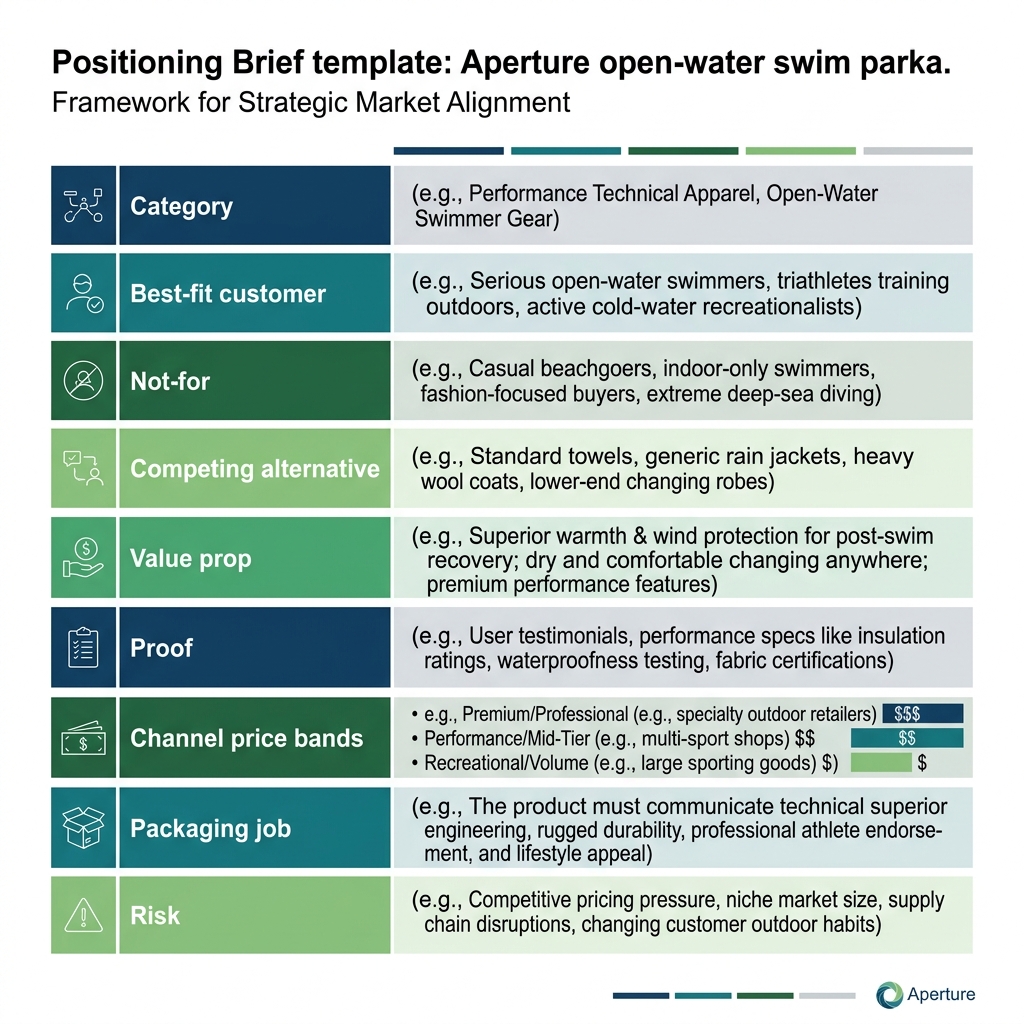 Exhibit: Positioning Brief template with Aperture fields
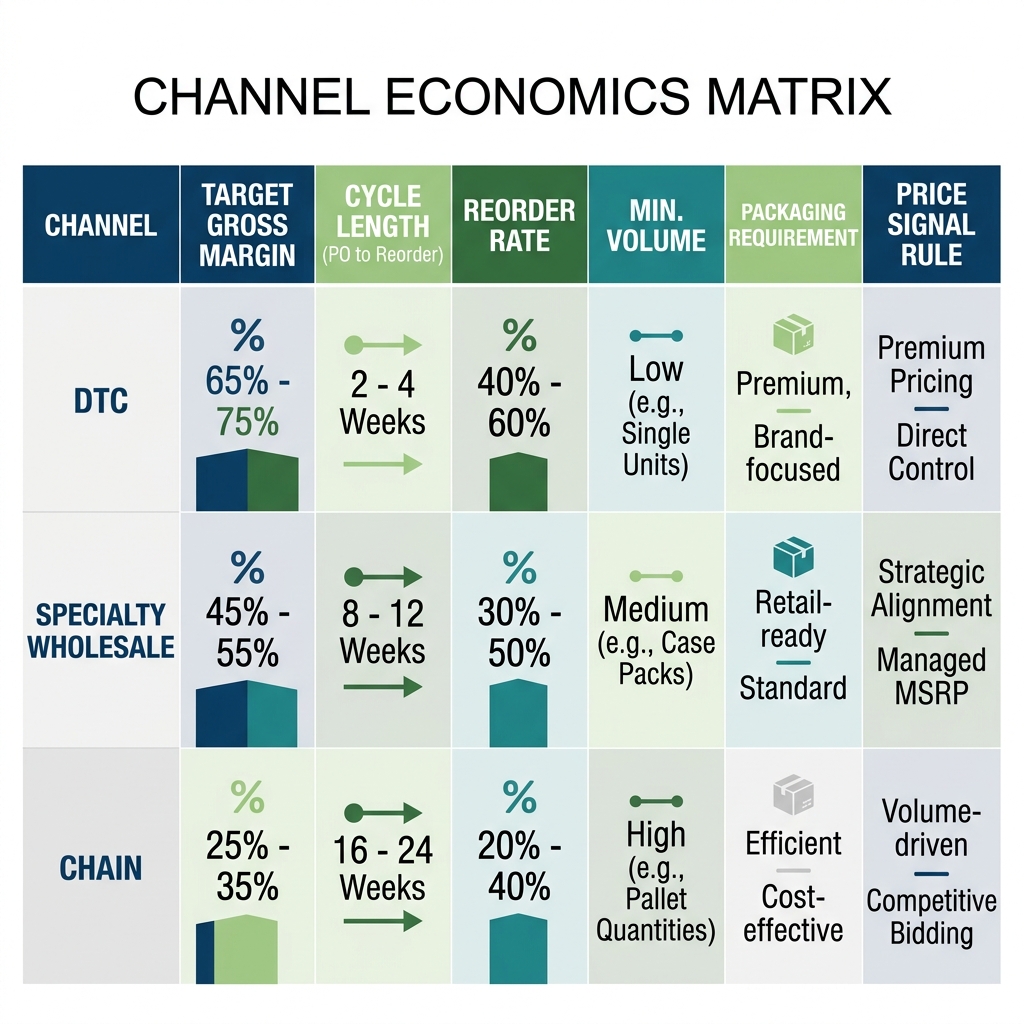 Exhibit: Channel economics matrix
The core problem: a 24 SKU backlog and a shared blind spot
Aperture Coastal Goods is a direct-to-consumer premium outdoor recreation brand selling kayaking, stand-up paddle, and open-water swimming gear. The company runs 110 people and $68M of revenue. The channel split is 55 percent DTC, 30 percent specialty wholesale across 340 independent outdoor retailers, and 15 percent chain distribution through 4 large sporting goods accounts. Head of Product Kenji runs a 24 SKU-per-year new product backlog. Head of Marketing Ines runs brand, performance, and the wholesale sell-in deck.
The pattern was familiar. Product would lock a concept, cut tooling, and hand finished goods to marketing 6 weeks before the catalog drop. Ines would write positioning against a product she had no authorship of. Specialty retail buyers would sit through sell-in meetings and ask the question every founder dreads. "What shelf does this go on and who is the customer walking in to buy it." If the brand rep could not answer in under 90 seconds, the account passed. Chain buyers were worse. They had to justify planogram space against a category they already stocked.
Kenji and Ines had no shared artifact. Product had a PRD. Marketing had a launch brief. Nobody had a single page that said what category the SKU entered, who it was for, and what it cost the buyer to choose it over the thing they were buying today. The cost of that gap was visible. A third of new SKUs under-performed their first-year wholesale forecast. The reorder rate across 340 specialty accounts was soft. Paid media on DTC kept lifting first orders but the margin was eroding because packaging could not carry the price.
The fix was not a new agency or a new brand platform. The fix was a discipline of resolving positioning before committing engineering. Seven pilot briefs in two quarters killed 3 SKUs before tooling, re-scoped 12 on position, redirected $2.4M of R&D into the winners, expanded DTC gross margin by 17 percent on the re-scoped SKUs, compressed specialty sell-in meetings by 38 percent, and lifted wholesale attach rate from 44 percent to 67 percent across the accounts that adopted the revised assortment.
Here is the operating discipline.
1. Write a one-page Positioning Brief before engineering starts
The Positioning Brief is one page. Not two. One. The constraint is the point. A one-page document forces the trade-offs to surface instead of hiding behind prose.
The brief has nine rows. Category (the shelf the product sits on in a retailer's mind). Best-fit customer (the specific buyer, described in a way a retail rep could recognize on sight). Not-for (the buyer who will return it, complain, or churn). Competing alternative (the product the buyer would otherwise purchase, including "nothing"). Value proposition (one sentence, written to the buyer, not to the internal team). Proof (the three things that make the claim credible at shelf or on a product page). Channel-specific price band (DTC, specialty, chain). Packaging job (what the box has to communicate in 4 seconds of shelf scan). Risk (the single assumption that most wants to be wrong).
At Aperture, the first pilot brief was for a new open-water swim parka. Draft one put the category as "cold water recovery." Draft three put the category as "post-swim thermal shell." The difference sounds small. It is not. The first framing put the parka next to neoprene wetsuits in a buyer's mind. The second put it next to technical outerwear. The specialty retail buyer stocks different SKUs in those two zones. The price band, the color story, and the packaging dieline all moved once the category line was settled. The engineering spec moved with it. Two fabric options were dropped. One zipper supplier was changed. Tooling was cut against a brief that already had a buyer, a shelf, and a price.
The brief is authored by product and marketing jointly. Neither owns it alone. The founder may contribute a conviction but the conviction is written as a hypothesis with a name attached, not as a closed decision. Packaging beats pricing. The brief says what the package has to do before it says what the price is.
2. Run the Best-Fit-Customer test against each channel's economics
A best-fit customer on DTC is not the same person as a best-fit customer in a specialty retailer, and neither is the same as the shopper who picks up a product in a chain sporting goods store. The Best-Fit-Customer test forces that distinction instead of papering over it.
For each channel, the test answers four questions. Who is the buyer. What is their purchase occasion. What margin does the channel require on this SKU for it to earn its shelf space. What is the reorder behavior that the channel needs to see in 90 days.
At Aperture, the swim parka cleared DTC easily. The best-fit DTC customer was a 38-year-old open-water swimmer who already owned a wetsuit and bought thermal gear online between October and March. Gross margin target 62 percent on DTC. The same SKU struggled on the specialty test. The best-fit specialty customer walked into a coastal outdoor store in early autumn looking for "something warm for after swims" without a brand in mind. Specialty margin floor was 48 percent to the retailer, which meant a wholesale price that the DTC pack could not support without a packaging change. The chain test failed outright. The chain buyer stocked a $79 fleece pullover from a house brand. The parka at $189 was not a substitute and not a complement.
The test result was not "kill the SKU." The test result was "ship DTC and specialty, skip chain this season, revisit the packaging for specialty shelf." That decision saved a planogram fight the brand would have lost. Across the 7 pilot briefs, 3 SKUs were killed when the Best-Fit-Customer test came back empty on every channel. Pricing is a signal before it is a number, and a signal that does not land on any channel's buyer is not a signal, it is a cost.
3. Commit a Willingness-to-Pay pre-read per channel
The Willingness-to-Pay pre-read is directional field research done before engineering commits. 20 to 40 best-fit customers per channel. Real packaging mockup, real shelf context, real price. The prompts are narrow. "What would you expect this to cost. Would you buy it at this price. What would you buy instead."
The output is not a demand curve. The output is a pattern of confusion, sticker shock, and substitution. Confusion means the customer cannot place the product in a category. Sticker shock means the customer placed it in the wrong category and priced it against the wrong alternative. Substitution means the customer named the real competing alternative, which may or may not match the brief.
At Aperture, the swim parka pre-read produced a clean substitution pattern on DTC. Open-water swimmers named a specific competitor's thermal robe as the alternative. The price the swimmers expected was $165 to $210. The brief had anchored at $189. Margin held. The specialty pre-read produced confusion. Store staff placed the parka next to wetsuits and did not know which shelf to stock it on. The packaging had failed its 4-second job. The fix was a dieline change with a thermal shell icon and a post-swim use case printed on the front panel. The price did not move. The packaging moved. Confusion is the enemy of willingness to pay, and the cheapest time to fix confusion is before the dieline goes to the printer.
The pre-read also flags the products that do not survive any channel. If the substitution pattern is "nothing, I would not buy this," the brief returns to the drawing board or the SKU is killed. Killing a SKU at pre-read is cheaper than killing it after $300K of tooling.
4. Hold a Product-Marketing Bridge ceremony as the gate
The Bridge is a ceremony, not a status meeting. It runs once every two weeks. Kenji and Ines co-chair. A finance partner attends to validate the channel margin math. Wholesale sales sends a rep. One specialty retail buyer, rotated across 4 key accounts, attends as an external voice.
The Bridge reviews any SKU approaching engineering kickoff. The gate has four checks. The Positioning Brief is complete and signed by product and marketing. The Best-Fit-Customer test has cleared at least one channel at target margin. The Willingness-to-Pay pre-read has returned a usable signal. The packaging job is defined and the dieline brief is in motion.
If any check fails, the SKU does not enter engineering. It goes back. If all four clear, the SKU enters engineering with a frozen brief. Changes to the brief after that point require a second Bridge review and a written reason. The discipline is that the brief becomes the contract between product and marketing for the life of the SKU. The best operators compete on discipline, not instinct, and the Bridge is where the discipline lives in the calendar.
At Aperture, the first two Bridge ceremonies were uncomfortable. The founder wanted to override a Best-Fit-Customer test that came back empty on a deck-shoe SKU. The ceremony held. The SKU was killed. The engineering time went to a paddle leash redesign that cleared all four checks in a single Bridge and shipped six months later with a 67 percent wholesale attach rate.
Three failure modes
The HiPPO-driven brief. The founder writes the brief alone and the team edits around the conviction. The brief becomes a ratification of taste. The fix is to write the founder's view as a named hypothesis and require the Best-Fit-Customer test before the brief is signed.
The marketing-retrofitted positioning. Engineering ships, and marketing is handed a finished product and asked to write positioning against it. The positioning is always a compromise because the category, the price, and the packaging are already set. The fix is the Bridge ceremony as a gate. No brief, no kickoff.
The positioning-without-channel-math brief. The brief reads beautifully and the pre-read clears, but the channel margin math was never validated. The SKU ships and the wholesale P&L bleeds. The fix is finance at the Bridge and a channel-economics matrix attached to every brief. At Aperture, a paddle board deck pad passed the brief and the pre-read on a Friday, then failed the channel math on the following Monday when the finance partner showed that specialty wholesale economics required a 48 percent retailer margin that the landed cost could not support. The SKU went back. The bill of materials was re-cut. The SKU shipped six weeks later with a thinner core layer and a lower landed cost. Margin held. The brief survived because the math was run before engineering committed.
A fourth pattern shows up often enough to name. The beautiful brief with no kill criterion. The brief describes a buyer, a category, a price, and a packaging job, but does not say what result in the pre-read would send the SKU back. Without a written kill criterion, every pre-read looks like a pass because the team is anchored on shipping. The fix is one line in the brief. "We will kill this SKU if the pre-read shows substitution to nothing on more than 40 percent of best-fit customers across at least two channels." That line is the difference between a brief that tests a product and a brief that ratifies one.
30-60-90 sprint to install this
Days 1 to 30. Pick 3 SKUs in the current backlog that are closest to engineering kickoff. Write a Positioning Brief for each. Do not block the backlog yet. Run the Best-Fit-Customer test against DTC only for now. Stand up the Bridge ceremony on a 2-week cadence with product, marketing, and finance. The goal is to produce 3 briefs and run 1 ceremony.
Days 31 to 60. Expand the Best-Fit-Customer test to specialty wholesale. Recruit a rotating specialty buyer to attend the Bridge. Run the first Willingness-to-Pay pre-read on one SKU. Begin the packaging dieline brief as a required attachment. Publish the channel-economics matrix as a shared template. The goal is that no new SKU enters engineering without a signed brief.
Days 61 to 90. Extend to chain distribution. Run pre-reads on 3 SKUs in parallel. Review killed SKUs and re-scoped SKUs with the founder and the board. Report the $ redirected and the margin and sell-in metrics. The goal is an operating rhythm, not a project. By day 90 the Bridge is a calendar fixture and the brief is the price of admission to the engineering backlog.
Next step
Run the free assessment or book a consultation to apply this framework to your specific situation.
References
- April Dunford. Obviously Awesome. Ambient Press, 2019.
- April Dunford. Sales Pitch. Ambient Press, 2023.
- Al Ries and Jack Trout. Positioning. McGraw-Hill, 2001 edition.
- Geoffrey Moore. Crossing the Chasm. HarperBusiness, 3rd edition, 2014.
- Marty Cagan. INSPIRED. Wiley, 2nd edition, 2017.
- Melissa Perri. Escaping the Build Trap. O'Reilly, 2018.
- Tony Ulwick. Jobs to be Done. Idea Bite Press, 2016.
- Seth Godin. This is Marketing. Portfolio, 2018.
- Bob Moesta. Demand-Side Sales 101. Lioncrest, 2020.
- Harvard Business Review. "The Elements of Value" and related pieces on consumer brand positioning. hbr.org/topic/brand-management.
- McKinsey and Company. DTC economics and the profitability challenge for digitally native brands. mckinsey.com/industries/consumer-packaged-goods.
- Gartner. Multi-channel attribution and the limits of last-click measurement. gartner.com/en/marketing.
- Forrester. The state of multi-channel retail attribution. forrester.com/research.
- Bain and Company. Specialty retail economics and the future of the independent channel. bain.com/industry-expertise/retail.
Company names and figures in worked examples are illustrative or changed to protect client confidentiality.
Questions, answered
8 QuestionsWhy resolve positioning before engineering starts instead of after the prototype lands?
Because positioning decisions control the bill of materials, the color story, the packaging dieline, the retail price point, and the sell-in deck. If you settle those after tooling is cut, you either ship a compromised product or you eat the rework. Our experience with Aperture Coastal Goods showed that 3 SKUs out of a 24 SKU backlog were killed before engineering because the Positioning Brief exposed a buyer with no willingness to pay at the wholesale price the margin model required. That money went back into the 12 SKUs that survived re-scoping.
How is a Positioning Brief different from a product requirements document (PRD)?
No. A PRD describes what the product is and how it works. A Positioning Brief describes who it is for, who it is not for, what category it enters, which competing alternative it displaces, and what the buyer believes before and after they see it. You can have a perfect PRD and still ship a product nobody knows how to shop for. The Positioning Brief is the document that answers the question a specialty retail buyer asks in the first 90 seconds of a sell-in meeting.
Do you run a separate Positioning Brief per channel for DTC, wholesale, and chain?
One brief per SKU, but with channel-specific rows for best-fit buyer, willingness to pay, and competing alternative. Aperture runs one brief per SKU across DTC, specialty wholesale, and chain distribution. The core category claim stays constant. The buyer and the price band shift per channel. That discipline is what lets one product carry a 55 percent DTC share, a 30 percent specialty share, and a 15 percent chain share without the brand splitting in three directions.
How long does it take to write a one-page Positioning Brief for a new SKU?
First drafts take a working session of about 90 minutes between product and marketing. Revisions happen across a week as field research fills in. The test of a finished brief is whether a new hire on the wholesale sell-in team can pick it up cold and describe the product, the buyer, and the shelf neighbor in under 3 minutes. If they cannot, the brief is not done. The document is short on purpose. One page forces the trade-offs to surface.
What does a Willingness-to-Pay pre-read actually measure for a new SKU?
It is a directional read, not a statistical one. You show the proposed packaging, a price, and the shelf context to 20 to 40 best-fit customers per channel and ask what they would expect to pay, whether they would buy at the offered price, and which alternative they would choose instead. You are looking for confusion, sticker shock, and substitution patterns. Packaging beats pricing in this test every time. Confusion is the enemy of willingness to pay.
Who owns the Product-Marketing Bridge gate before engineering kickoff?
Both heads own it jointly. In the Aperture case, Kenji as Head of Product and Ines as Head of Marketing co-chair the ceremony. Neither signs off alone. A CFO or finance partner attends to validate the channel margin math. The ceremony is a gate, not a status meeting. If the brief fails any of the four checks, the SKU does not enter engineering. Seven pilot ceremonies in the first two quarters killed 3 SKUs and re-scoped 12.
How do you avoid the HiPPO problem where the founder overrides the Positioning Brief?
You write the founder's conviction into the brief as a stated hypothesis with the name next to it. Then you run the Best-Fit-Customer test against it. The founder is allowed to be right. The founder is not allowed to skip the test. The operators who compete on discipline, not instinct, are the ones who survive a bad product year. The brief exists to separate the founder's taste from the founder's unchecked taste.
Does positioning-before-build apply if we only sell DTC and skip wholesale?
Yes, with less machinery. The channel-economics matrix collapses to one column. The Positioning Brief and the Willingness-to-Pay pre-read still apply. Pure DTC brands get into trouble when they confuse a Facebook ad click with a real buyer. Specialty wholesale and chain distribution make positioning mistakes expensive and visible. Pure DTC brands make the same mistakes, just more slowly and with more wasted paid media. The discipline still pays.
How to resolve positioning, best-fit customer, and willingness to pay before engineering starts on a new SKU, using a one-page Positioning Brief and a Product-Marketing Bridge ceremony as the gate.
How relevant and useful is this article for you?
About the Author(s)
 Emily Ellis is the Founder of FintastIQ. Emily has 20 years of experience leading pricing, value creation, and commercial transformation initiatives for PE portfolio companies and high-growth businesses. She has previous experience as a leader at McKinsey and BCG and is the Founder of FintastIQ and the Growth Operating System.
Further reading
- April Dunford. Obviously Awesome. Page Two, 2019
- Rob Fitzpatrick. The Mom Test. Createspace, 2013
- Geoffrey Moore. Crossing the Chasm. HarperBusiness, 2014
- Clayton M. Christensen, Scott Cook & Taddy Hall. Marketing Malpractice: The Cause and the Cure. Harvard Business Review, 2005
- Clayton M. Christensen, Taddy Hall, Karen Dillon & David Duncan. Competing Against Luck. HarperBusiness, 2016